When is the least crowded time to visit the Grand Canyon?

Spanning 277 river miles across northern Arizona, the Grand Canyon is one of the Seven Natural Wonders of the World. Every year, nearly 5 million travelers flock from across the globe—and particularly from major flight corridors in California, New York, Texas, and Washington—to gaze into its mile-deep red rock chasms.
However, standing shoulder-to-shoulder with thousands of tourists, waiting 45 minutes for a shuttle bus, or hunting for parking at Mather Point can quickly diminish the serene, awe-inspiring majesty of the canyon.
If your ideal adventure involves crisp solitude, quiet trails, uninterrupted photography, and uncrowded shuttle buses, timing is everything.
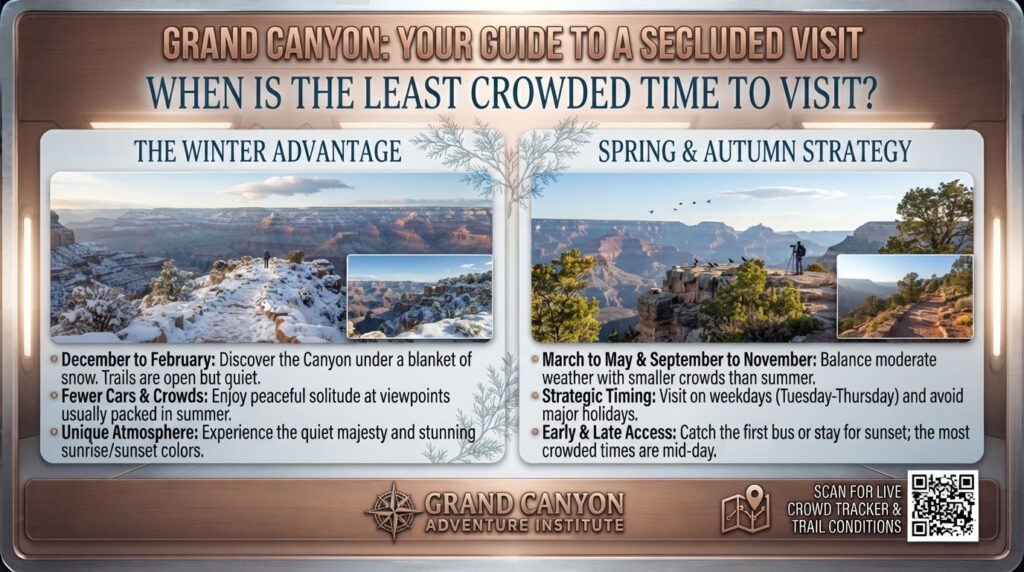
The absolute least crowded time to visit the Grand Canyon is during the winter off-season—specifically from December through February (excluding the Christmas to New Year’s holiday week). During these cold-weather months, daily visitation drops by up to 75% compared to peak summer months.
If sub-freezing temperatures aren’t your style, late autumn (November) and early spring (late February to March) offer the ultimate sweet spot of low crowd density and manageable weather.
This comprehensive eco-travel guide breaks down month-by-month visitation data, daily timing strategies, rim comparisons, gear reviews for off-peak hiking, and 10 detailed FAQs to help you plan an unforgettable, crowd-free Grand Canyon expedition.
The Grand Canyon Crowds Matrix: Month-by-Month Breakdown
To choose the best travel window, it helps to understand how visitor traffic fluctuates throughout the calendar year.
                     MONTHLY CROWD DENSITY AT GRAND CANYON
                                       │
       ┌───────────────────────────────┼───────────────────────────────┐
       ▼                               ▼                               ▼
[ OFF-PEAK / LOW ]            [ SHOULDER / MODERATE ]           [ PEAK CROWDS ]
Dec • Jan • Feb                Apr • May • Sep • Oct             Jun • Jul • Aug
Daily: ~5,800–6,500            Daily: ~15,000–18,000             Daily: 25,000+
       │                               │                               │
       ▼                               ▼                               ▼
Quiet, snowy rims,             Best weather-to-crowd             Packed shuttles, long
lowest lodging rates.          ratio for hiking.                 gate queues, 100°F+ heat.
Grand Canyon Visitation & Climate Summary
| Month | Average High / Low (°F) | Est. Daily Visitors | Crowd Index | Best For |
| January | 45° / 18° | ~5,800 | Very Low | Total solitude, snow photography, maximum lodging savings |
| February | 48° / 21° | ~6,200 | Very Low | Wildlife watching, quiet trails, crisp visibility |
| March | 54° / 27° | ~11,000 | Low to Moderate | Early spring hikers, warmer afternoons |
| April | 60° / 32° | ~15,500 | Moderate | Wildflower blooms, prime inner-canyon hiking |
| May | 69° / 39° | ~18,000 | Moderate-High | North Rim reopening (May 15), warm days |
| June | 81° / 47° | ~23,500 | High | Summer vacationers (heavy traffic & long lines) |
| July | 84° / 54° | ~25,800 | Peak | Family travel (busiest month of the year) |
| August | 82° / 53° | ~24,100 | Peak | Monsoon storm photography, late-summer breaks |
| September | 75° / 47° | ~17,200 | Moderate | Pleasant weather, post-Labor Day drop in families |
| October | 65° / 36° | ~14,000 | Moderate | Fall colors on North Rim, ideal rim-to-rim hiking |
| November | 52° / 24° | ~8,500 | Low | Peace & quiet before winter (except Thanksgiving week) |
| December | 43° / 17° | ~7,000 | Low (Excl. Holidays) | Festive atmosphere, snowscapes (crowded Dec 24–Jan 1) |
Detailed Seasonal Analysis: When Solitude Meets Strategy
1. The Winter Off-Season (December to February): Ultimate Solitude
If your top priority is avoiding people, winter is king. Following the Thanksgiving rush, visitor volume collapses. Throughout January and February, daily visitor counts hover around 5,800 people per day—compared to over 25,000 in July.
                     WINTER ADVANTAGES VS. CHALLENGES
                                     │
       ┌─────────────────────────────┴─────────────────────────────┐
       ▼                                                           ▼
[ PROS ]                                                    [ CONS ]
• 70–75% fewer tourists than summer                   • North Rim is completely closed
• Crystal-clear air visibility (90+ miles)             • Freezing temps (high 40s°F, low 18°F)
• Easy walk-in dining & lower lodging rates            • Ice & snow require microspikes on rim trails
- Visual Beauty: Snow blankets the red canyon terraces, creating stunning contrast for landscape photography.
- Crucial Note: The North Rim closes to vehicle traffic from December 1 to May 14 due to heavy snow accumulation. All winter visits focus on the South Rim.
2. The Golden Shoulder Seasons: Spring (April–May) & Fall (September–October)
If freezing temperatures sound unappealing, the shoulder seasons represent the “sweet spot” for eco-travelers seeking mild weather alongside reduced crowds.
- Fall (September & October): After Labor Day, school starts up across the U.S., causing family travel numbers to drop sharply. September brings pleasant 75°F daytime temperatures, perfect for hiking down Bright Angel or South Kaibab trails. October offers golden foliage along the North Rim before its mid-October vehicle closure.
- Spring (April & May): Spring break in late March causes a brief spike, but April settles into comfortable 60°F weather with wildflowers blooming along lower canyon trails.
3. Avoid Peak Summer (June through August)
Summer is when the park is at its absolute maximum capacity. Traffic jams at the South Entrance Gate in Tusayan can stretch over an hour. Shuttle buses operate at standing-room-only capacity, and heat at the canyon floor frequently exceeds 105°F (40°C), making inner-canyon hiking dangerous.
Strategic Micro-Timing: How to Beat Crowds Any Day of the Year
Even if you must visit during a busier month, you can bypass 80% of park congestion by adjusting your daily routine:
  [ 5:30 AM – 8:30 AM ] ──► EARLY BIRD WINDOW   ──► Zero gate lines, empty rim trails, golden light.
  [ 10:00 AM – 3:30 PM ] ──► PEAK TOURIST SURGE  ──► Gridlock parking, long shuttle lines, packed rim.
  [ 4:30 PM – SUNSET ]   ──► EVENING DISSIPATION ──► Day-trippers leave; peaceful sunset viewpoints.
- Arrive Before 8:00 AM: Tour buses and day-trippers from Las Vegas, Phoenix, and Flagstaff generally arrive between 10:00 AM and 2:00 PM. Entering the park at dawn guarantees easy parking at Visitor Center lots and empty rim paths.
- Hike Past the First Mile: Over 90% of Grand Canyon visitors never venture more than 0.5 miles from their vehicle or shuttle drop-off. Walking just 1 to 2 miles down Bright Angel Trail or along the Rim Trail toward Hermit’s Rest drops crowd density instantly.
- Explore East Rim / Desert View Drive: Major crowd bottlenecks concentrate around Mather Point, Bright Angel Lodge, and Yavapai Geology Museum. Driving east toward Grandview Point, Lipan Point, or Desert View Watchtower yields far fewer tour groups.
- Visit Mid-Week: Tuesday through Thursday consistently see 20–30% fewer day visitors than weekends.
Gear Reviews: Essential Products for Off-Peak & Winter Canyon Exploration
Visiting during the quiet off-peak season requires proper preparation for cold winds and icy trail switchbacks. Here are four top-rated gear recommendations for a comfortable winter or late-fall eco-adventure:
1. Kahtoola MICROspikes Footwear Traction
- Best Essential Security for Winter & Spring Trail Hiking
When hiking down South Rim switchbacks between December and April, upper trail sections are routinely covered in packed ice and hard snow. Kahtoola MICROspikes slip over standard hiking boots to deliver immediate traction.
- Key Specifications:
- Spike Material: Heat-treated 3/8-inch stainless steel spikes (12 spikes per foot).
- Elastomer Harness: Flexible down to -30°F (-34°C).
- Pros: Prevents dangerous slips on icy trailheads (Bright Angel / South Kaibab); compact pouch fits in any daypack; lightweight (~11 oz).
- Cons: Must be taken off once you descend past the snow line into warmer inner-canyon dirt.
2. Arc’teryx Atom Heavyweight Hoody
- Best Cold-Weather Insulated Mid-Layer
Rim temperatures in winter regularly hover between 18°F and 45°F with biting canyon winds. A wind-resistant, highly breathable insulated jacket is crucial for comfortable rim walks.
- Key Specifications:
- Insulation: Coreloft synthetic insulation (retains heat even if damp).
- Face Fabric: Tyono 30 shell with DWR (durable water repellent) finish.
- Pros: Exceptionally lightweight-to-warmth ratio; cuts severe rim wind chill; highly packable for daytime temperature shifts.
- Cons: High-tier price investment.
3. Black Diamond Trail Pro Shock Trekking Poles
- Best Stability Support for Steep Incline Descents
Descending into the canyon places heavy strain on knees and joints. Trekking poles provide essential balance, especially on icy or loose gravel switchbacks.
- Key Specifications:
- Shaft Material: 7075 Aluminum.
- Adjustment: FlickLock Pro mechanism; integrated shock-absorbing technology.
- Pros: Reduces knee impact on steep downhills; provides four points of contact on slick trail sections; quick depth adjustment.
- Cons: Adds slight carrying weight when strapped to daypack.
4. Osprey Talon 22 (Men’s) / Tempest 20 (Women’s) Daypack
- Best Sustainable Daypack for Eco-Explorers
Constructed from bluesign-approved recycled high-tenacity nylon, this iconic daypack holds extra thermal layers, water bladders, traction spikes, and snacks for day trips.
- Key Specifications:
- Capacity: 20 to 22 Liters.
- Hydration Compatible: External sleeve fits up to a 3L reservoir.
- Pros: BioStretch harness distributes weight comfortably; sustainable eco-friendly materials; excellent ventilation back-panel.
- Cons: Not fully waterproof (requires rain cover for heavy winter storms).
Gear Comparison Matrix for Off-Peak Explorers
| Gear Item | Primary Function | Weight | Best Season | Value Rating |
| Kahtoola MICROspikes | Trail Ice Traction | 11 oz | Dec – April | Essential (10/10) |
| Arc’teryx Atom Hoody | Wind & Thermal Layering | 16 oz | Nov – March | Premium (9/10) |
| BD Trail Pro Poles | Joint Stability on Switchbacks | 18 oz | Year-Round | High (9.5/10) |
| Osprey Talon/Tempest | Sustainable Gear Carrying | 32 oz | Year-Round | High (9.5/10) |
South Rim vs. North Rim vs. West Rim: Crowd Comparison
Understanding where to go within the Grand Canyon national ecosystem is just as important as when to go:
  [ SOUTH RIM ]   ──► 80% of all visitors. Open year-round. Best amenities, highest summer crowds.
  [ NORTH RIM ]   ──► 10% of all visitors. Open May 15–Oct 15. Lush, forested, peaceful.
  [ WEST RIM ]    ──► Hualapai Tribal Land (Skywalk). Close to Las Vegas; busy with tour buses.
1. South Rim (Open 365 Days a Year)
- Crowd Factor: Busiest rim. Houses Grand Canyon Village, Mather Point, Bright Angel Trailhead, and major lodges.
- Off-Peak Vibe: During winter and late fall, the South Rim transforms into a tranquil, high-altitude sanctuary with easy parking and empty overlooks.
2. North Rim (Open Seasonally: May 15 – October 15)
- Crowd Factor: Sees only 10% of total park traffic.
- Off-Peak Vibe: Located at 8,000+ feet elevation, the North Rim features dense pine forests, cooler temperatures, and zero crowds compared to the South Rim. Visiting in late September or early October offers prime fall colors and near-total quiet before winter closure.
5 Practical Eco-Tips for Low-Impact, Uncrowded Travel
- Ride the Free NPS Shuttle Buses: When visiting the South Rim, park your vehicle once at the Visitor Center and use the natural-gas shuttle buses to access Hermit Road or Tusayan Route stops.
- Pack Out All Trash (Leave No Trace): Cold weather slows decomposition. Carry a small trash bag in your pack to haul out all food scraps, apple cores, and micro-trash.
- Carry Reusable Water Bottles: Avoid single-use plastic water bottles. The park features free, spring-fed filtered water refill stations at major trailheads (Bright Angel, South Kaibab, Hermit’s Rest).
- Respect Winter Wildlife: Winter is a stressful survival season for resident wildlife like elk, mule deer, and California condors. Maintain at least 100 feet of distance and never feed animals.
- Support Local Gateway Communities: Consider staying in historic gateway towns like Williams or Flagstaff, Arizona, or booking eco-certified lodging inside the park.
Frequently Asked Questions (FAQ)
1. What is the single least crowded month to visit the Grand Canyon?
January is statistically the least crowded month of the year, averaging around 5,800 daily visitors—a 75% reduction in crowd volume compared to July.
2. Is the Grand Canyon open during the winter?
Yes, the South Rim is open 24 hours a day, 365 days a year, including all major holidays. However, the North Rim closes to vehicle traffic between December 1 and May 14 due to snow accumulation.
3. Does it snow at the Grand Canyon?
Yes! The South Rim rests at an elevation of 7,000 feet, and the North Rim sits above 8,000 feet. The park receives frequent winter snowfall between December and March, dusting the canyon walls in white.
4. Are trails open when there is ice or snow on the rim?
Yes, trails like Bright Angel and South Kaibab remain open year-round. However, the upper 1 to 2 miles of trails are usually icy and slippery in winter. Wearing footwear traction spikes (like Kahtoola MICROspikes) and using trekking poles is strongly recommended.
5. When is the best time to visit if I want both good weather AND low crowds?
The “golden window” is late September through October or mid-April through May. These shoulder months offer warm daytime temperatures (60°F–75°F) with roughly 40–50% fewer tourists than peak summer.
6. Is lodging cheaper during the least crowded months?
Yes. Hotel rates inside the park (Xanterra Lodges) and in gateway towns like Tusayan, Williams, and Flagstaff drop by 20% to 40% during the winter off-season (December through February, excluding Christmas week).
7. What time of day is the least crowded at major viewpoints?
Early morning from sunrise until 8:30 AM is the quietest time of day year-round. Most tour buses arrive around mid-morning, so early risers enjoy completely uncrowded viewpoints.
8. Is the North Rim worth visiting to avoid crowds?
Absoloutely. The North Rim receives only a fraction of the park’s annual visitors. It provides a rustic, forested, peaceful environment—though it is only accessible between May 15 and October 15.
9. Are restaurants and services open inside the park during off-peak months?
Yes, core services on the South Rim—including El Tovar Dining Room, Bright Angel Lodge, Yavapai Lodge, grocery markets, gas stations, and medical clinics—operate year-round.
10. Do I need advance reservations to enter the Grand Canyon during off-peak times?
Unlike some national parks (such as Yosemite or Arches), Grand Canyon National Park does not currently require timed-entry day-use reservations. You simply pay the standard $35 vehicle entrance fee (or show your America the Beautiful Pass) at the gate.
Conclusion
If you want to experience the raw, timeless grandeur of the Grand Canyon without wading through heavy summer crowds, plan your journey during the winter off-season (December to February) or the autumn shoulder season (October to November).
By trading 100°F summer heat for crisp winter air or crisp fall breezes, you’ll gain access to empty trailheads, effortless parking, discounted lodging, and a quiet connection to one of the planet’s greatest natural wonders. Gear up with warm layers and microspikes, arrive at sunrise, and enjoy the canyon in blissful solitude.