

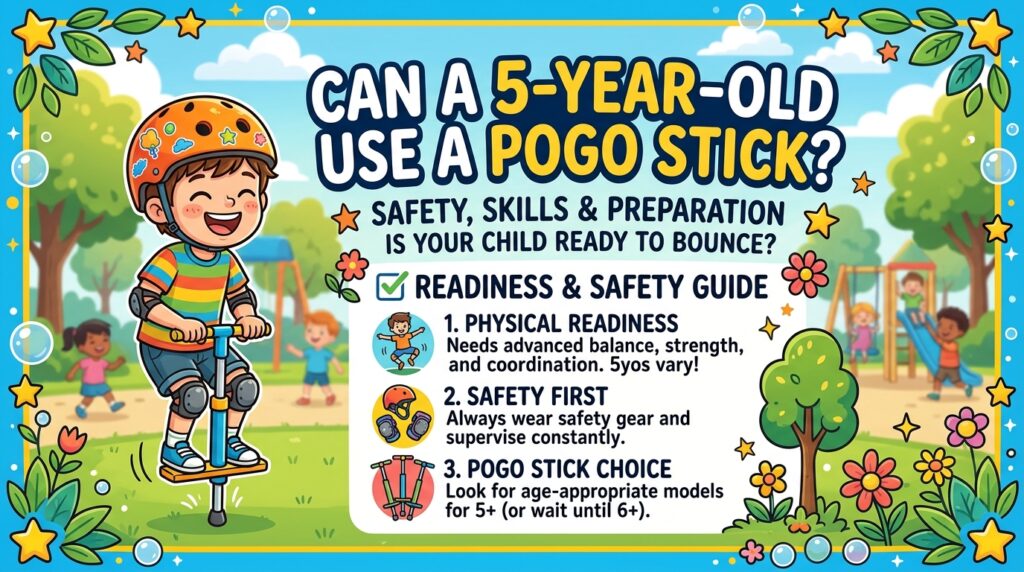
The sight of a pogo stick usually triggers two immediate reactions in parents: a sense of nostalgic wonder and a sudden, sharp concern for their child’s front teeth. When your 5-year-old points at one in a toy store or sees a neighborhood kid bouncing down the sidewalk, the question is inevitable: Is a 5-year-old actually old enough, strong enough, and coordinated enough to use a pogo stick?
The short answer is yes, but with a major “catch.” A 5-year-old cannot use a standard, metal-spring pogo stick designed for older children. However, they are at the perfect developmental stage for “beginner” pogo technology.
In this definitive guide, we will explore the physical milestones of a 5-year-old, the specific types of pogo sticks safe for this age group, and the safety protocols every parent needs to know.
1. Developmental Readiness: Is Your 5-Year-Old Ready?
At five years old, a child is in a rapid phase of “gross motor” development. This is the age where they transition from simple movements to complex coordination.
The Physical Milestones
To use even a beginner pogo stick, a 5-year-old should be able to:
- Balance on one foot for at least 5 to 10 seconds.
- Jump with both feet leaving the ground simultaneously.
- Follow two-step directions (e.g., “Hold the handles, then jump”).
The “Weight” Problem
Most traditional metal pogo sticks have a minimum weight requirement of 40 to 80 pounds. The average 5-year-old weighs between 37 and 45 pounds. If a child is too light, they cannot compress the heavy steel spring. They will simply stand on a rigid pole and tip over. This is the primary reason “real” pogo sticks are usually rated for ages 9 and up.
2. The Solution: The “My First Pogo” (Foam Bungee)
For a 5-year-old, the best—and arguably only—safe option is the Foam Bungee Jumper. This is a modern evolution of the pogo stick designed specifically for the preschool and kindergarten demographic.
How It Works:
Instead of a metal frame and a spring, it consists of:
- A durable foam base: This acts as the “pogo” part. It is soft, stable, and often includes a squeaker.
- A stretchy bungee cord: This replaces the rigid metal pole.
- Soft handles: Designed for small hands to grip comfortably.
Why It’s Perfect for Age 5:
- Safety: There are no hard metal parts to fall on. If they lose their balance, they simply step off the foam block.
- Indoor Use: The foam base won’t scratch your hardwood floors or patio.
- Skill Building: It teaches the “rhythm” of jumping and the core engagement needed for later, more advanced pogo sticks.
3. The Junior Metal Stick: A Rare Exception
If your 5-year-old is exceptionally tall, heavy for their age (over 40 lbs), and highly coordinated, you might consider a Junior Metal Pogo Stick.
However, these are usually marketed for “Ages 5 to 9,” but most parents find that kids aren’t truly ready for the metal version until age 6 or 7. If you go this route, look for:
- Foam-wrapped frames: To protect their legs from bruises.
- Extra-wide footpegs: For better stability.
- A very soft spring: Specifically rated for light weights.
4. Safety First: The 5-Year-Old Protocol
If you decide to let your 5-year-old start hopping, safety is non-negotiable. At this age, their center of gravity is higher, and their sense of balance is still a “work in progress.”
Mandatory Gear:
- Helmet: A fall from even a foam pogo can result in a head-to-floor collision. A standard bike helmet is a must.
- Sneakers: Never allow pogo-ing in flip-flops, crocs, or bare feet. They need the grip of a rubber sole to stay on the base.
- Clear Space: Remove all toys, furniture, and sharp corners from the “jump zone.”
The “Spotter” Role:
For the first few weeks, you should act as a spotter. Stay within arm’s reach. Most 5-year-olds tend to “lean” too far forward or backward. You can gently stabilize their shoulders until they find their “center.”
5. Benefits of Pogo-ing for 5-Year-Olds
Beyond just burning off that legendary kindergarten energy, pogo sticks offer genuine developmental perks:
- Core Strength: Staying upright on a pogo stick engages the abdominal and back muscles.
- Vestibular Development: This is the sensory system that handles balance and spatial orientation. Bouncing is one of the best ways to “tune” this system.
- Confidence: The first time a child hits five bounces in a row, the boost to their self-esteem is massive.
6. Buying Guide: What to Look For
When shopping for a 5-year-old, avoid “Big Kid” brands like the Pogo Master or Extreme models. Look for these keywords:
- “Bungee”
- “Foam”
- “Toddler-friendly”
- “Weight rated for 30+ lbs”
7. Comparison: Foam vs. Metal for Age 5
| Feature | Foam Bungee (Recommended) | Junior Metal (Caution) |
| Safety Level | High | Moderate |
| Weight Minimum | None (Usually 30 lbs+) | 40–50 lbs |
| Balance Difficulty | Easy (Stable base) | Hard (Single point) |
| Indoor Safe? | Yes | No |
| Durability | Moderate | High |
Final Thoughts: Should You Buy One?
Yes! A foam bungee pogo stick is one of the best “activity” gifts you can give a 5-year-old. It’s safer than a scooter, more engaging than a standard ball, and provides a great foundation for physical fitness.
Just remember: Skip the steel, go for the foam. Let them master the rhythm of the bounce now, and by the time they are 8 or 9, they’ll be ready to transition to a “real” pogo stick with confidence and skill.
Expert Guide: A Quick Follow-up
Is your 5-year-old currently using other “balance” toys like a scooter or a balance bike, or would this be their first step into the world of coordination-based play?