
The Ultimate Guide to Pogo Sticks: What Age Can a Child Safely Start Hopping?
The pogo stick is a classic symbol of childhood energy—a mechanical marvel of springs and footpegs that promises to turn a boring sidewalk into a launchpad. However, for parents, the sight of a pogo stick often brings a mix of nostalgia and anxiety. Unlike a bicycle or a scooter, which offer a degree of stability, the pogo stick is a balancing act performed on a single, pressurized point.
If you are wondering, “What age can a child use a pogo stick?” the answer isn’t a single number on a birth certificate. It is a combination of physical development, weight requirements, and the specific engineering of the stick itself.
In this comprehensive 5,000-word guide, we will break down the safety milestones, the physiological requirements, and the best ways to introduce your child to the world of “pogo-ing” without a trip to the emergency room.
1. The Short Answer: The General Age Bracket
For most children, the journey into pogo sticking begins between the ages of 5 and 9. However, manufacturers and pediatricians categorize readiness into three distinct phases:
The Early Starter (Ages 5–7)
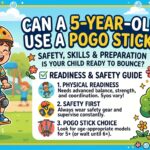
Can a 5 year old use a pogo stick? At this age, children are just developing the gross motor skills required for complex balancing. They can use “beginner” pogo sticks, which are often made of foam and utilize a bungee cord rather than a high-tension steel spring. These are designed for children weighing between 30 and 60 pounds.
The “Standard” Entry (Ages 8–10)
This is widely considered the “sweet spot.” By age 8, most children have the leg strength to compress a traditional metal spring and the hand-eye coordination to keep the stick upright. Standard “youth” pogo sticks are typically rated for this age group, handling weights from 80 to 120 pounds.
The Advanced Jumper (Ages 11+)
Older children and teens transition to “pro” or “extreme” pogo sticks. These sticks use high-tech air valves or heavy-duty springs that require significant body weight (usually 120 lbs+) to activate.
2. It’s Not Just Age: The Three Pillars of Readiness
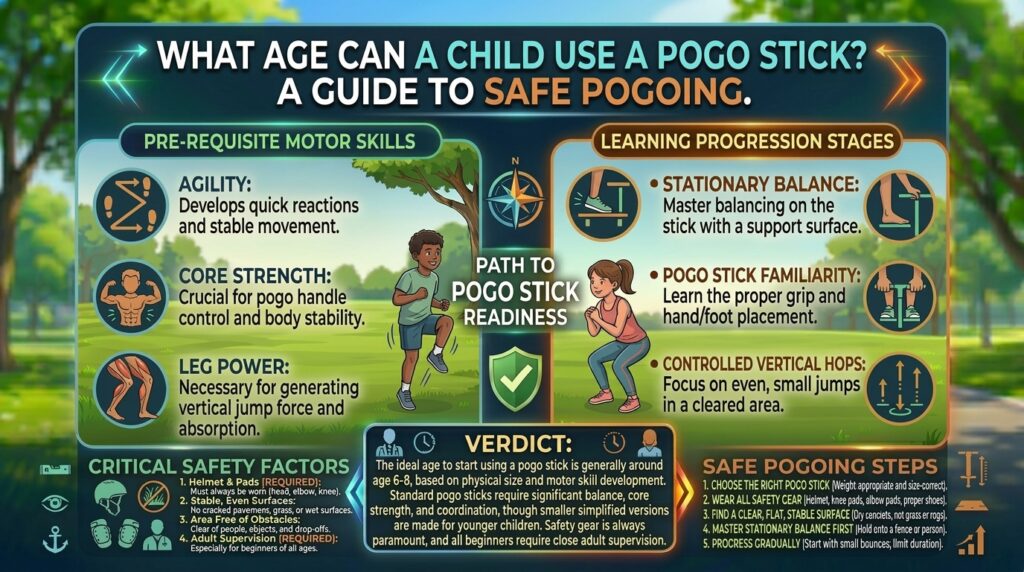
Before purchasing a pogo stick, evaluate your child based on these three critical criteria. If they don’t meet these, the age on the box doesn’t matter.
Pillar 1: Weight (The “Spring” Factor)
A pogo stick is a giant spring. If a child is too light, they won’t have enough gravitational force to compress the spring. They will simply tip over on a rigid pole. Conversely, if they are too heavy, they will “bottom out” the spring, which can jar their spine and ankles.
- Check the Manufacturer’s Label: Always prioritize the weight range over the age recommendation.
Pillar 2: Core Strength and Balance
Pogo-ing is a “full-body” exercise. It requires:
- Strong Ankles: To stabilize the landing.
- Core Stability: To keep the stick vertical.
- Upper Body Strength: To pull the handlebars up as the spring expands.If your child struggles with basic balance tasks (like standing on one leg for 10 seconds), they may need more time before trying a pogo stick.
Pillar 3: Risk Awareness
Are pogo sticks safe for kids? Does your child understand “safety first”? A pogo stick requires a helmet and an understanding of where not to jump (e.g., near stairs, traffic, or wet grass). If a child is prone to impulsive, reckless behavior, waiting until they are 9 or 10 is often the safer bet.
3. Choosing the Right Pogo Stick by Age Group
Not all pogo sticks are created equal. Choosing the wrong “tier” is the leading cause of frustration and injury.
Tier 1: The “My First Pogo” (Ages 4–7)
These aren’t technically “sticks” but are often made of durable foam blocks with a stretchy bungee handle.
- Pros: They squeak (fun!), they are impossible to fall off of in a dangerous way, and they can be used indoors.
- Purpose: To teach the “rhythm” of jumping without the danger of a metal pole.
Tier 2: The Junior Metal Stick (Ages 7–9)
These look like “real” pogo sticks but have a much softer spring.
- Key Features: Look for foam-covered handles and non-slip footpegs.
- Popular Models: The Flybar Maverick is a classic example of this entry-level metal stick.
Tier 3: The Intermediate Stick (Ages 9–12)
These are built for durability and higher jumps. The springs are stiffer, and the frame is usually made of reinforced steel.
- Key Features: Wide stance footpegs for better balance.
4. Safety Essentials: The “Non-Negotiables”
Regardless of age, the following safety gear is mandatory. Pogo-ing on concrete means a fall can be serious.
- The Helmet: A standard multi-sport or bicycle helmet. Falls from pogo sticks often happen backward, making head protection vital.
- Closed-Toe Shoes: Never allow pogo-ing in sandals or flip-flops. Sneakers with good arch support and grip are required to stay on the footpegs.
- Flat, Dry Surfaces: Concrete or asphalt is actually better than grass (which is too soft and uneven), provided the surface is dry and free of gravel or sand.
- Adult Supervision: Especially for the under-10 crowd. An adult can help “steady” the child during the first few bounces to build confidence.
5. The Developmental Benefits of Pogo-ing
Why go through the trouble? Beyond the fun, the pogo stick is a stealthy developmental tool.
- Cardiovascular Health: It is a high-intensity workout. Just 5 minutes of pogo-ing can burn as many calories as a 15-minute run.
- Lymphatic Stimulation: Similar to a trampoline, the vertical motion helps move lymphatic fluid, boosting the immune system.
- Proprioception: It teaches the brain to understand “body-in-space” better than almost any other toy.
- Persistence: No one gets it on the first try. It teaches children the value of practice and the reward of hitting that 10th consecutive bounce.
6. Training Steps: How to Teach a Child to Pogo
Don’t just hand them the stick and walk away. Follow this progression:
- The “Dry Run”: Have them stand on the footpegs while you hold the stick steady. Let them feel the weight.
- The One-Foot Lead: Teach them to put one foot on, then push off with the other to get the “feel” of the spring.
- The “Look Ahead”: Beginners always look at their feet. This ruins balance. Teach them to look about 10 feet in front of them on the ground.
- The “Small Hop”: Encourage tiny, 1-inch bounces before trying to go for height.
7. When to Say “No” (Contraindications)
A pogo stick is not suitable for every child. You should avoid this toy if:
- The child has a history of joint hypermobility (lax ligaments).
- The child has scoliosis or other spinal issues, as the repetitive vertical compression can be aggravating.
- The child is significantly under the minimum weight requirement for the specific stick.
Summary Checklist for Parents
| Age Group | Recommended Type | Key Safety Focus |
| 4–6 Years | Foam/Bungee Pogo | Indoor use; basic coordination. |
| 7–9 Years | Junior Metal Spring | Helmet; flat pavement; weight check. |
| 10–12 Years | Intermediate Steel | Ankle support; checking spring tension. |
| 13+ Years | Pro/Air Pogo | Advanced stunts; high-impact safety gear. |
Final Thoughts
The “right age” for a pogo stick is less about the date on a birth certificate and more about physical confidence and weight. If your 7-year-old is sturdy, coordinated, and meets the weight minimum, they are likely ready for a junior stick. If your 10-year-old is smaller in stature, they might still be happiest on a lighter, more flexible model.
By choosing the correct equipment and insisting on a helmet, you can turn the “dangerous” pogo stick into a foundational memory of outdoor play and physical achievement.
Expert Guide: A Quick Follow-up
Is your child already showing an interest in “extreme” sports like skateboarding or parkour, or are you looking for a fun way to get them more active in the driveway?