
Can “Taking on Challenges” be developed in children who are naturally risk-averse?

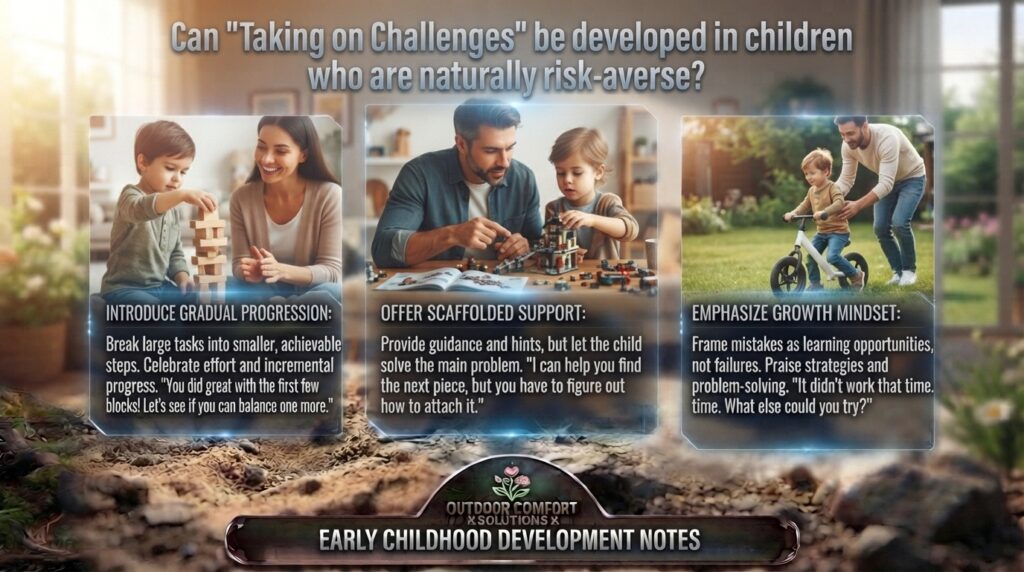
Every parent recognizes the temperament: the child who stands at the edge of the playground in Austin, watching others climb the structure but refusing to let go of the railing; the student in New York City who avoids raising their hand unless they are 100% sure of the answer; or the child in San Francisco who prefers the safety of a known puzzle over the uncertainty of a new game.
While we often praise the “daring” child, the risk-averse child possesses a different, equally valuable set of traits: careful observation, deep consideration, and a high sense of self-preservation. However, the world requires us to step into the unknown. If your child struggles with stepping out of their comfort zone, you might be asking: Is this a fixed trait, or can I help them develop the skill of “Taking on Challenges”?
The answer is a resounding yes. At My Eco Adventure, we believe that courage is not the absence of fear, but the ability to take the next step despite it.
Understanding the Risk-Averse Mindset
Risk-averse children are not necessarily “fearful”—they are often high-precision thinkers. They assess the potential for failure, embarrassment, or physical harm more intensely than their peers. In a fast-paced society like those in Washington or California, where the culture often pushes for “constant growth,” these children can feel overwhelmed.
To develop the skill of taking on challenges, we must move away from the “just do it” mentality and move toward “strategic exploration.”
7 Strategies to Cultivate “Challenge-Taking” Skills
1. Reframe “Failure” as “Data Collection”
Risk-averse children often view a mistake as a character flaw.
- The Strategy: When something goes wrong, treat it like an experiment. Instead of saying “Oops, we messed up,” say, “Interesting! That didn’t work the way we thought. What does that tell us about how to do it next time?”
- The Outcome: This removes the emotional weight of failure and replaces it with the intellectual curiosity of a scientist.
2. The Power of “Micro-Goals”
A mountain looks insurmountable from the bottom. A single step, however, is manageable.
- The Strategy: If your child is afraid to join a team sport, don’t demand they play the game. Ask them to just stand on the sidelines and hold the equipment for ten minutes.
- The Outcome: By breaking a challenge into “micro-goals,” you allow them to experience success at every stage, which builds the confidence required for the full task.
3. Model “Vulnerable Risk-Taking”
If you are always the “perfect” parent, your child learns that perfection is the standard.
- The Strategy: Let them see you try something you aren’t good at. Talk through your process: “I’m a little nervous about cooking this new recipe, but I’m excited to see how it tastes!”
- The Outcome: They learn that being “bad” at something is part of the process of becoming “good” at it.
4. Celebrate the “Effort,” Not the Outcome
In high-pressure school districts, children often become risk-averse because they fear getting the “wrong” answer.
- The Strategy: Praise the process. “I saw how hard you worked to figure out that math problem, even when you weren’t sure of the answer.”
- The Outcome: This shifts their identity from “the smart kid who gets it right” to “the resilient kid who keeps working.”
5. Create a “Safe” Environment for Experimentation
Sometimes, the best place to practice risk is in a controlled, low-consequence environment.
- The Strategy: Use nature as a laboratory. Climbing a small, stable rock in a park or trying a new hiking trail provides a physical challenge that is inherently grounded.
- The Outcome: Nature rewards patience and careful movement, which aligns well with the risk-averse child’s natural temperament.
6. Provide “The Safety Net”
Risk-averse children need to know that if they fall, they will be caught.
- The Strategy: Before they take a challenge, ask them: “What’s the worst that could happen, and what can we do if that happens?”
- The Outcome: By mentally preparing for the “worst case,” the fear loses its power. They feel equipped to handle the outcome.
7. Limit the Pressure of “Comparison”
Avoid comparing your child to the “daredevil” sibling or peer.
- The Strategy: Focus on their own timeline. “Look at how much higher you climbed today compared to last week!”
- The Outcome: Self-comparison fosters internal growth, whereas external comparison breeds anxiety.
10 Frequently Asked Questions (FAQ)
1. Is being risk-averse a permanent personality trait? No. While temperament has a genetic component, the skill of taking on challenges is highly malleable and can be strengthened through practice.
2. Is it bad to let my child stay in their comfort zone? Not always. Everyone needs a “home base.” The goal isn’t to live outside the comfort zone, but to make the comfort zone larger.
3. What if my child refuses to try altogether? Don’t force them. If they resist, back off, but leave the door open: “It’s okay not to do it today. Let’s try again when you feel ready.”
4. How does this apply to social challenges? The same principles apply. Small social risks—like asking a peer for the time or joining a group activity for only five minutes—are the “micro-goals” of social challenge-taking.
5. Is “taking on challenges” the same as being fearless? Absolutely not. It is the ability to acknowledge fear and move forward anyway.
6. Does technology impact risk-aversion? Often, yes. Digital worlds are highly controlled. Encourage analog, outdoor adventures where the environment is unpredictable to help them adapt to real-world variables.
7. How do I know if the challenge is “too big”? If the child is consistently shutting down or exhibiting high levels of distress, the challenge is likely too big. Scale it back.
8. Should I reward them for taking a risk? Avoid tangible rewards like money or toys. Use verbal encouragement that emphasizes their bravery: “You were really brave to try that.”
9. Are some kids just wired to be more cautious? Yes, and those kids often become great planners, engineers, and observers. Frame their caution as a strength that needs a little “bravery boost.”
10. How long does it take to see change? It is a slow, quiet process. You likely won’t see a dramatic shift overnight, but over months, you will see a subtle change in their willingness to raise their hand or try a new activity.
Conclusion
Development is a marathon, not a sprint. For a risk-averse child, the world can feel like a series of potential pitfalls. However, by validating their need for safety, providing clear scaffolding, and praising the effort of the attempt, you are giving them the most important tool for success: the belief that they can navigate the unknown.
At My Eco Adventure, we encourage parents to embrace the small, daily opportunities to step into the “just-outside-the-comfort-zone” space. Whether it’s in the streets of San Francisco or the wild landscapes of Texas, your support is the anchor that allows them to cast off and explore.