
How can I foster “Perspective Taking” in my toddler when they struggle to understand why a sibling is upset?

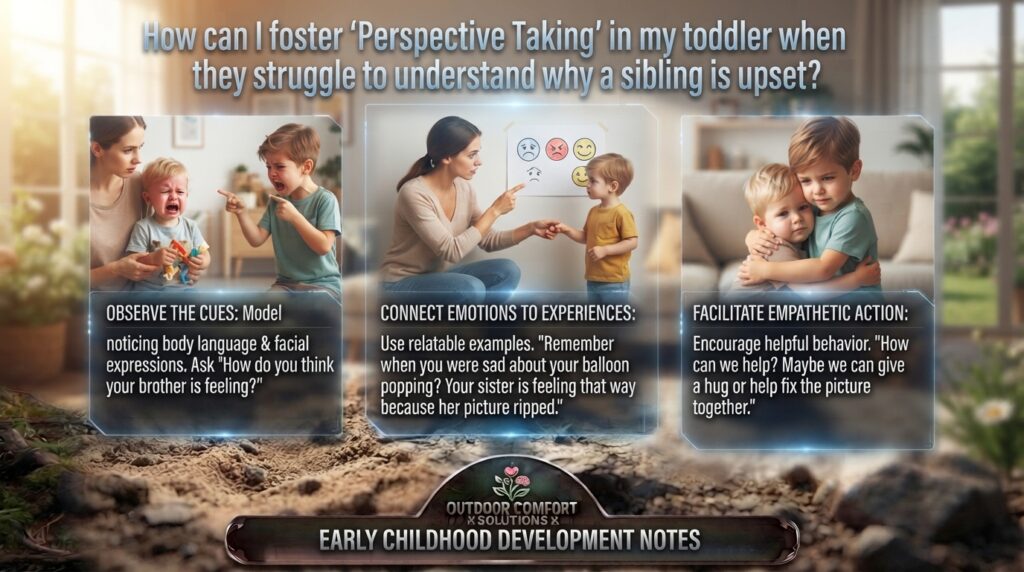
Sibling conflict is an inevitable part of family life. Whether it’s a dispute over a favorite toy, a clash over personal space, or simple frustration, these moments often feel like chaos for parents. However, these conflicts are actually “golden opportunities” for emotional development.
At the heart of this growth is a skill known as perspective taking—the ability to understand that someone else has thoughts, feelings, and desires that are different from one’s own. For a toddler, this is a major developmental leap.
In this guide, we will explore how you can move from “referee” to “coach,” helping your children navigate their relationships while building the empathy that will serve them for a lifetime.
The Developmental Reality: Why Toddlers Struggle
Before diving into strategies, it is important to manage expectations. Toddlers are naturally “egocentric”—not because they are selfish, but because their brains are still developing the neural pathways required for complex social understanding.
Most children begin to grasp the concept that others have different feelings around age 4 or 5. Expecting a two-year-old to fully understand why their sibling is crying when they just want the same truck is biologically premature. Your goal is not perfection; it is consistent exposure. Every time you gently guide them toward the other person’s perspective, you are laying a brick in their foundation of empathy.
5 Practical Strategies to Foster Perspective Taking
You don’t need to be an expert to help your child develop empathy. The most effective methods are simple, repeatable, and rooted in connection.
1. Label and Validate Emotions
Toddlers often lack the vocabulary to describe their internal states. When you label emotions, you provide the tools they need to recognize them in others.
- The Approach: If your child takes a toy, look at the sibling and say, “Your brother looks really sad. He was playing with that truck, and now it’s gone.”
- Why it works: It shifts the focus from the action (taking the toy) to the impact (the sibling’s sadness).
2. Use “Perspective-Taking” Questions
When things are calm, use stories or pretend play to practice. In the heat of a conflict, keep your questions simple.
- The Approach: Ask, “How do you think your sister feels right now?” or “How would you feel if someone took your favorite bear away?”
- The Goal: You aren’t looking for a perfect answer. You are asking them to pause and consider a point of view other than their own.
3. Model Empathy in Your Daily Life
Children are master observers. They learn more from how you treat them—and others—than from any lecture.
- The Approach: When you see someone who is upset, verbalize your empathy. “That person looks sad because they dropped their groceries. Let’s hold the door for them.”
- The Impact: This shows that noticing others’ feelings is a normal, everyday behavior.
4. Move Beyond “I’m Sorry”
Insisting on a forced “I’m sorry” often leads to hollow compliance. Instead, focus on making things right.
- The Approach: Instead of demanding an apology, ask, “Your sister is crying because she got hurt. What can we do to help her feel better?”
- The Outcome: This encourages restorative action (like offering a tissue or a hug) rather than just repeating a phrase they don’t yet understand.
5. Play Games That Require Cooperation
Structure playtime to require working together. Cooperative games force children to communicate and consider their partner’s next move.
- The Approach: Try building a Lego tower together or working on a shared puzzle.
- The Benefit: These activities create natural friction where children must negotiate and consider each other’s ideas to reach a common goal.
Creating a Home Environment for Emotional Growth
Your home environment acts as a greenhouse for these skills. Establishing clear routines and ground rules reduces the anxiety that often fuels impulsive behavior.
- Set Clear Ground Rules: When everyone is calm, discuss expectations. “In this house, we don’t snatch toys.”
- Fair vs. Equal: Openly discuss why siblings might have different rules. Explaining why an older sibling has a later bedtime helps a younger child understand that different people have different needs.
- Validate the “Big” Feelings: Don’t rush to fix the sadness or anger. When a child feels heard, they are far more capable of hearing someone else.
10 Frequently Asked Questions
1. Is it normal for my toddler to show zero empathy? Yes. Toddlers are naturally egocentric. Empathy is a skill that develops slowly over years. Focus on consistency rather than immediate results.
2. Should I force my children to share every toy? Not necessarily. Forcing sharing can lead to resentment. Instead, focus on turn-taking using a timer, which helps children learn that they will get the toy back.
3. What do I do when my toddler is too angry to listen? Wait. You cannot teach a lesson when a child is in the “red zone.” Help them calm down first, then discuss the conflict later when they are ready to learn.
4. How can I use stories to teach perspective? Read books about feelings and pause to ask questions. “Why do you think the character is crying? What would make them feel better?”
5. Does my child’s lack of empathy mean they will be unkind? Absolutely not. It simply means their brain is still maturing. It is a sign of development, not a character flaw.
6. Can I use TV shows to help with perspective taking? Yes. Watch a show together and mute it. Ask your child to guess how the characters are feeling based on their body language and facial expressions.
7. How do I handle sibling jealousy over parental attention? Acknowledge it directly. “I know it’s hard when I’m holding the baby. I love you both so much, and you’ll get your turn for a cuddle in a minute.”
8. Is “perspective taking” the same as “empathy”? They are closely related. Perspective taking is the cognitive ability to understand someone’s state, while empathy is the emotional resonance with that state.
9. How do I handle a child who hits during conflicts? Stop the action immediately, keep them safe, and clearly state: “I cannot let you hit. Hitting hurts.” Keep the message short and firm.
10. How do I know if we are making progress? Look for small wins: a moment where they pause before acting, or a time they check on their sibling without being prompted. These are the markers of growth.
Conclusion
Fostering perspective taking is not about avoiding conflict, but about using it to build a bridge between your children. By staying patient, modeling kindness, and focusing on the “why” behind emotions, you are nurturing children who will eventually navigate their social world with confidence and compassion.
Remember, you are the most powerful influence in their world. Keep practicing, keep talking, and most importantly, keep connecting.