

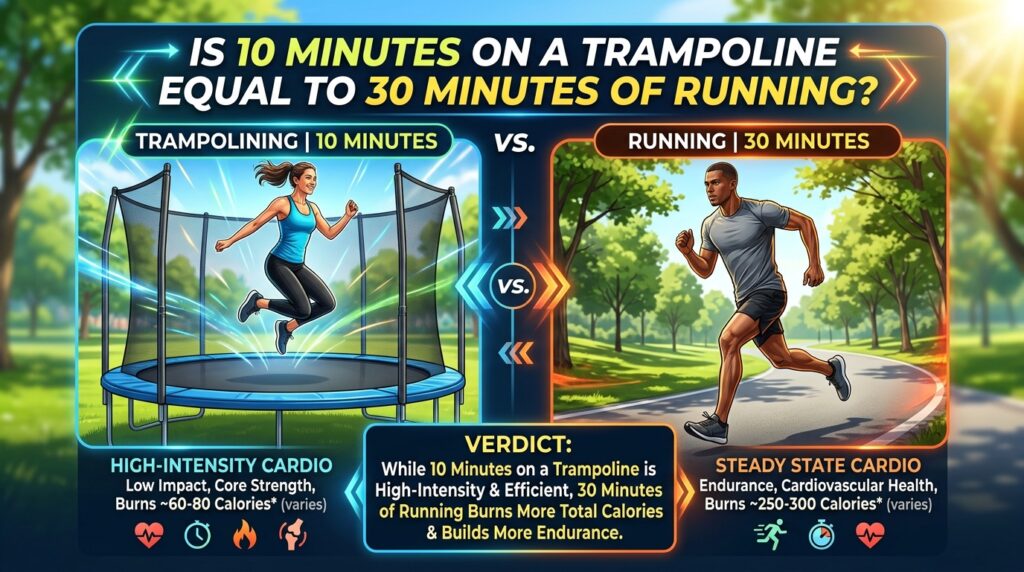
The Great Cardio Debate: Is 10 Minutes on a Trampoline Truly Equal to 30 Minutes of Running?
For decades, a specific “fitness fact” has bounced around gyms and health blogs: “Ten minutes on a trampoline is better for you than 30 minutes of running.” It sounds like the ultimate fitness “cheat code.” Who wouldn’t want to cut their workout time by two-thirds while having a bit of childhood fun?
But is this claim rooted in physiological reality, or is it just clever marketing from the rebounder industry? To find the truth, we have to look at the science of G-force, metabolic cost, and how our bodies respond to different types of impact.
1. The NASA Study: Where the Legend Began
Most people citing the “10 vs. 30” rule are actually referencing a 1980 study conducted by NASA’s Biomedical Research Division.
What NASA Actually Found
The researchers were looking for a way to help astronauts regain bone density and muscle mass after returning from zero-gravity environments. They compared running on a treadmill to jumping on a trampoline.
Using sophisticated sensors, they measured heart rate, oxygen consumption ($VO_2$), and the “G-force” experienced at different parts of the body. Their findings were revolutionary:
- Efficiency: At similar levels of heart rate and oxygen consumption, the magnitude of the bio-mechanical stimuli was greater with jumping.
- The “68%” Rule: The study suggested that for a similar level of effort, rebounding was about 68% more efficient than running.
The Misinterpretation
While the study proved rebounding was highly efficient, it didn’t explicitly say 10 minutes replaces 30 minutes for every person in every scenario. However, the fitness world took that “68% more efficient” figure and streamlined it into the catchy “10 equals 30” slogan we know today.
2. The Physics of the Bounce: G-Force and Acceleration
To understand why a trampoline feels different than a pavement run, we have to look at physics.
Deceleration and Acceleration
When you run, your body hits a hard surface. Your joints (ankles, knees, hips) absorb a jarring impact. When you jump on a trampoline, the mat stretches. This creates a unique cycle:
- Acceleration: Pushing off the mat.
- Weightlessness: The split second at the top of the jump.
- Deceleration: Landing on the mat, which absorbs the impact and then pushes back.
On a trampoline, every cell in your body is subject to this G-force. At the bottom of the bounce, you can experience up to double your body weight in pressure. This “vertical loading” forces your muscles—and even your internal organs and cells—to strengthen to handle the load.
3. Caloric Burn: Rebounding vs. Running
If your goal is weight loss, the “10 vs. 30” claim needs a reality check regarding calories.
| Activity | Intensity | Est. Calories (30 mins) |
| Running | 6 mph (10 min/mile) | 300 – 350 kcal |
| Rebounding | Moderate/Vigorous | 210 – 270 kcal |
| Walking | 3.5 mph | 120 – 150 kcal |
The Verdict: While rebounding is significantly more intense than walking and offers a higher burn per minute than low-impact aerobics, 10 minutes of rebounding will generally not burn as many calories as 30 minutes of steady-state running.
However, if you perform High-Intensity Interval Training (HIIT) on a trampoline, you can narrow that gap significantly due to the “afterburn effect” (EPOC).
4. The “Hidden” Benefits of the Trampoline
While the calorie-for-calorie math might not perfectly support the 10:30 ratio, rebounding offers several benefits that running simply cannot match.
Lymphatic Drainage
The lymphatic system is the body’s “garbage disposal,” responsible for removing toxins and waste. Unlike the circulatory system, which has the heart to pump blood, the lymph system relies entirely on body movement. The up-and-down motion of jumping acts as a literal pump for the lymph valves, potentially boosting immune function.
Joint Longevity
Running is a high-impact sport. Over time, the repetitive “pounding the pavement” can lead to stress fractures and osteoarthritis. A trampoline mat absorbs about 80% of the shock, allowing you to get a high-intensity cardiovascular workout without destroying your knees.
Balance and Proprioception
Jumping on an unstable surface forces the brain to constantly communicate with the stabilizing muscles in the core and ankles. This improves “proprioception”—your body’s ability to sense its position in space.
5. Which One Should You Choose?
Choose Running If:
- You are training for a race (marathon, 5K).
- You want maximum calorie burn in a single session.
- You enjoy being outdoors and covering distance.
Choose Rebounding If:
- You have sensitive joints or a history of knee/back pain.
- You are short on time and want a quick “metabolic spike.”
- You want to improve balance and lymphatic health.
- You find traditional cardio boring (the “fun factor” is a real metric for consistency!).
Final Thoughts: The Reality Check
Is 10 minutes on a trampoline equal to 30 minutes of running? Physiologically, not quite. In terms of pure aerobic output and muscular stimulation, 10 minutes of vigorous jumping is likely closer to 20 minutes of running.
However, the “best” exercise is the one you actually do. If you find running miserable but love jumping, the trampoline will always be the more effective tool for your health. Instead of looking for a shortcut, look for a sustainable rhythm. If that means bouncing your way to fitness for 15 minutes a day, your heart and joints will certainly thank you.
Is the “10 vs 30” rule a bit of an exaggeration? Yes. Is the trampoline still one of the most efficient, low-impact, and scientifically-backed ways to get fit? Absolutely.