Is Grand Canyon West (Skywalk) part of Grand Canyon National Park?

If you are planning a trip to Arizona from California, Texas, New York, or Washington, one of the most common points of confusion is whether Grand Canyon West—famous for its glass-bottom Skywalk—is part of Grand Canyon National Park.
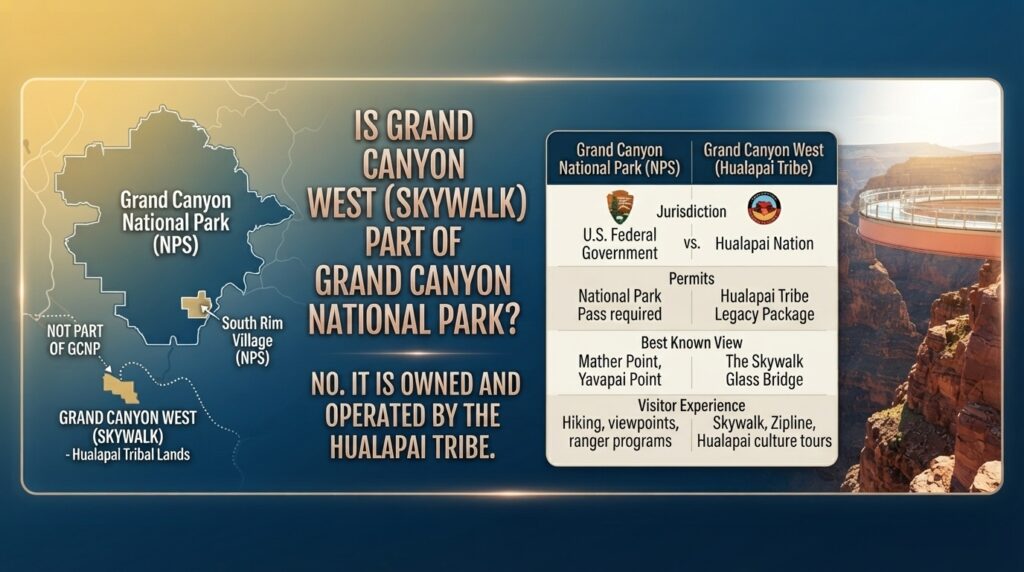
The short answer is no. Grand Canyon West is completely separate from Grand Canyon National Park. It is a commercial tourism destination located on tribal land owned and operated by the Hualapai Native American Tribe.
At myecoadventure.com, we focus on providing eco-conscious travel insights to help road-trippers and park enthusiasts navigate complex destinations. In this comprehensive guide, we compare governance, ticketing, driving distances, costs, and attractions between Grand Canyon West and the National Park to help you choose the best destination for your travel style.
The Core Difference: Tribal Land vs. Federal National Park
While both destinations overlook the same geological marvel carved by the Colorado River, their management, fee structures, and visitor experiences are completely different.
┌────────────────────────────────────────────────────────────────────────────────────────┐
│                                 THE GEOLOGICAL CANYON                                  │
└───────────────────────────┬────────────────────────────────┬───────────────────────────┘
                            │                                │
                            ▼                                ▼
       ┌───────────────────────────────┐          ┌──────────────────────────────┐
       │       GRAND CANYON WEST       │          │  GRAND CANYON NATIONAL PARK  │
       ├───────────────────────────────┤          ├──────────────────────────────┤
       │ • Hualapai Tribal Sovereignty │          │ • Federal NPS Management     │
       │ • Private Business Enterprise │          │ • Public Protected Land      │
       │ • 2.5 Hours from Las Vegas    │          │ • 4.5 Hours from Las Vegas   │
       │ • Home of the Glass Skywalk   │          │ • Historic South & North Rim │
       └───────────────────────────────┘          └──────────────────────────────┘
1. Grand Canyon West (The West Rim)
- Owner & Operator: Owned by the Hualapai Tribe (Hualapai Department of Tourism).
- Location: Peach Springs, Arizona (approximately 125 miles east of Las Vegas).
- Land Status: Sovereign tribal reservation land outside federal jurisdiction.
- Pass Acceptance: America the Beautiful National Parks Passes are NOT accepted here.
2. Grand Canyon National Park (South Rim & North Rim)
- Owner & Operator: Managed by the National Park Service (NPS) under the U.S. Department of the Interior.
- Location: Grand Canyon Village, Arizona (South Rim) and Jacob Lake, Arizona (North Rim).
- Land Status: Federally protected national park land.
- Pass Acceptance: Accepts standard NPS Interagency Annual Passes, Senior Passes, and Military Passes.
Comparison Table: Grand Canyon West vs. Grand Canyon National Park
Before booking tours or driving out into the Arizona desert, review these key operational differences side by side:
| Feature / Metric | Grand Canyon West (West Rim) | Grand Canyon National Park (South Rim) |
| Primary Attraction | The Glass Skywalk & Helicopter River Landings | Mather Point, Bright Angel Trail, Desert View |
| Distance from Las Vegas | ~125 miles (2.5-hour drive) | ~275 miles (4.5-hour drive) |
| Distance from Phoenix | ~250 miles (4.25-hour drive) | ~225 miles (3.5-hour drive) |
| Entry Fee System | General Admission Package (~$50–$65 per person) | Vehicle Pass ($35 per vehicle valid for 7 days) |
| Skywalk Add-On Cost | ~$28–$35 additional per person | Not Available (No Skywalk exists in NPS park) |
| National Park Pass Accepted? | No (Tribal entry required) | Yes ($80 Interagency Pass accepted) |
| Personal Photography on Skywalk | Prohibited (Locker storage mandatory) | N/A (Unrestricted across all viewpoints) |
| In-Park Transportation | Hop-on hop-off Tribal Shuttle Bus | Hop-on hop-off NPS Free Shuttle Bus |
| Personal Vehicles Allowed? | No (Must park at terminal & shuttle in) | Yes (Drive to view points & rim parking lots) |
| Pet Friendliness | Very Limited (Service animals only) | High (Leashed pets allowed on paved Rim Trail) |
Deep Dive: What Makes Grand Canyon West Unique?
Grand Canyon West was developed by the Hualapai Tribe to support economic self-sufficiency on their reservation. While it lacks the sheer scale and historic stone architecture of the South Rim, it offers experiences that are strictly prohibited inside the National Park:
1. The Skywalk Bridge
Constructed in 2007, the Skywalk is a horseshoe-shaped cantilevered glass bridge that extends 70 feet out over the canyon rim, suspending visitors 4,000 feet above the canyon floor.
Important Rule on Photography: To protect the structural glass floor from scratches and dropped objects, visitors cannot bring personal cell phones, cameras, or backpacks onto the Skywalk bridge. Lockers are provided, and tribal staff photographers take photos that you can purchase afterwards.
2. Helicopter Landings on the Canyon Floor
In Grand Canyon National Park, commercial helicopter landings at the bottom of the canyon are strictly illegal to preserve wilderness tranquility. However, at Grand Canyon West, helicopters are permitted to land on private tribal land directly along the edge of the Colorado River, where visitors can take pontoon boat rides.
3. Guano Point & Eagle Point Views
- Eagle Point: Home to the Skywalk and a natural rock formation shaped like an eagle spreading its wings. It also features a Native American Cultural Village with traditional tribal dwellings.
- Guano Point: Offers 360-degree panoramic views of the canyon and the historical remnants of a 1950s aerial tramway that once mined bat guano from a cave across the river gorge.
Regional Travel Planning: Visiting from Target States
If you are traveling to the Grand Canyon from major metropolitan hubs across California, Texas, Washington, or New York, choosing between the West Rim and South Rim usually depends on your time constraints:
                            [ ORIGIN CITY / STATE ]
                                       │
       ┌───────────────────────────────┼───────────────────────────────┐
       ▼                               ▼                               ▼
[ SAN FRANCISCO / LA ]           [ TEXAS / SEATTLE ]            [ NEW YORK CITY ]
 - Driving or 1-hr Flight         - Direct Flights to               - Transcontinental Flight
   to Las Vegas (LAS)               PHX or LAS                        to PHX or LAS
 - Choose WEST RIM for            - Choose WEST RIM for             - Choose SOUTH RIM for
   quick 1-day side trip            quick photo stop                  classic 2-day park stay
From San Francisco & California
- Best Strategy: If you are flying into Las Vegas (LAS) for a weekend getaway, Grand Canyon West is the most logical choice. At just 2.5 hours away, you can take a morning shuttle or drive a rental car, experience the Skywalk, and return to Las Vegas by dinnertime.
- For South Rim: Driving from LA or Bay Area directly to the South Rim takes 8 to 12 hours, making it better suited for extended road trips.
From Washington State (Seattle)
- Best Strategy: Direct flights from Seattle-Tacoma (SEA) into Las Vegas (LAS) make West Rim day-tours very popular. However, if your goal is wilderness hiking (e.g., Bright Angel Trail or Rim-to-Rim), fly into Phoenix (PHX) and head straight to the South Rim National Park instead.
From Texas (Dallas, Houston, Austin)
- Best Strategy: Texas travelers flying into Phoenix Sky Harbor (PHX) are closer to the South Rim (3.5 hours drive). If flying into Las Vegas, Grand Canyon West is much closer.
From New York & Tri-State Area
- Best Strategy: Transcontinental visitors investing in a bucket-list trip generally prefer Grand Canyon National Park (South Rim) for its historic lodges, expansive trail network, and traditional park scenery.
Cost Analysis: How Do the Fees Compare?
One of the biggest surprises for first-time visitors is the difference in entry costs. Because Grand Canyon West operates as a tribal business enterprise rather than a tax-subsidized national park, pricing is structured on a per-person model rather than a per-vehicle fee.
[ GRAND CANYON WEST (Per Person) ]          [ NATIONAL PARK (Per Vehicle) ]
  • General Admission: ~$50 - $65             • Vehicle Pass (7 Days): $35
  • Skywalk Add-On:    ~$25 - $35             • Covers up to 15 passengers
  • Meal / Photo Extras: ~$30+                • Accepts $80 NPS Annual Pass
  ---------------------------------           ---------------------------------
  TOTAL (Family of 4): ~$320 - $400           TOTAL (Family of 4): $35 (or FREE w/ Pass)
If you are traveling with a family of four, entry to Grand Canyon West with Skywalk passes can quickly exceed $300 to $400, whereas entry to Grand Canyon National Park costs $35 per vehicle for an entire week.
10 Frequently Asked Questions (FAQ)
FAQ 1: Can I use my National Park Pass at Grand Canyon West?
No. The America the Beautiful Interagency Pass is only valid at federally managed sites (National Parks, National Monuments, BLM land). Because Grand Canyon West is located on sovereign Hualapai Tribal Reservation land, federal passes are not recognized, and separate entrance tickets must be purchased.
FAQ 2: Is the glass Skywalk worth visiting?
If you are short on time, staying in Las Vegas, and want a thrilling thrill-walk over a 4,000-foot drop, the Skywalk is a unique experience. However, if you are looking for classic hiking trails, deep solitude, and sweeping national park vistas without paying per-person fees, the South Rim offers better value.
FAQ 3: How far is Grand Canyon West from Grand Canyon National Park?
Grand Canyon West and Grand Canyon National Park (South Rim) are approximately 240 miles apart. The drive between the two sites takes roughly 4 hours along Interstate 40 and Route 66. They are not adjacent.
FAQ 4: Can I take photos on the Skywalk with my phone?
No. Cell phones, cameras, smartwatches, and personal belongings are prohibited on the glass bridge to prevent accidental drops that could scratch or crack the glass panels or hit visitors below. Lockers are provided free of charge, and professional photos are available for purchase.
FAQ 5: Which rim of the Grand Canyon is closest to Las Vegas?
Grand Canyon West (West Rim) is the closest rim to Las Vegas, located approximately 125 miles (a 2.5-hour drive) away. The South Rim is 275 miles away (4.5 hours), and the North Rim is 265 miles away (4.5 hours).
FAQ 6: Is Grand Canyon West paved and accessible for wheelchairs?
Yes. Grand Canyon West provides accessible parking, paved walkways around the main visitor terminal, and wheelchair-accessible hop-on hop-off shuttle buses that transport guests between Eagle Point, Guano Point, and the Hualapai Ranch.
FAQ 7: Can I drive my own car to the viewpoints at Grand Canyon West?
No. Visitors must park their personal vehicles at the main Grand Canyon West Airport/Visitor Terminal. From there, you must purchase an admission ticket and use the Hualapai Tribe’s hop-on hop-off shuttle system to reach Eagle Point and Guano Point.
FAQ 8: Are pets allowed at Grand Canyon West?
Pets are generally not allowed on the shuttle buses or at the main viewpoints (Eagle Point and Guano Point), with the exception of certified service animals. In contrast, Grand Canyon National Park allows leashed pets on all paved rim trails at the South Rim.
FAQ 9: Do I need a permit to visit Grand Canyon West?
No advance permit is required for standard day visits. You can purchase entrance and Skywalk tickets online in advance or directly at the terminal ticket counter upon arrival.
FAQ 10: Can I hike into the canyon at Grand Canyon West?
Hiking opportunities into the inner gorge are very limited at Grand Canyon West compared to the National Park. There are short walking paths around Guano Point and Eagle Point, but there are no developed rim-to-river hiking trails like Bright Angel or South Kaibab Trail.
Conclusion
To summarize: Grand Canyon West and its famous Skywalk are NOT part of Grand Canyon National Park.
- Choose Grand Canyon West if you are staying in Las Vegas, have limited time, want to walk on the glass Skywalk, or are interested in helicopter river landings on Hualapai tribal land.
- Choose Grand Canyon National Park (South Rim) if you have an NPS pass, want classic national park lodges, plan on hiking into the canyon, or want a traditional, multi-day outdoor national park experience.
For more eco-friendly travel guides, park comparisons, and desert road-trip itineraries, explore our latest updates on myecoadventure.com before your next journey!