
When travelers envision the Grand Canyon, their minds typically jump to vast red rock amphitheaters, sun-baked desert cliffs, and sweeping arid plateaus. Yet every autumn, a magnificent and little-known natural spectacle unfolds across northern Arizona: autumn foliage.
For travelers flying in from major metropolitan hubs in California, Texas, New York, Washington, and San Francisco, catching peak fall colors against the backdrop of a mile-deep gorge is a once-in-a-lifetime eco-adventure.
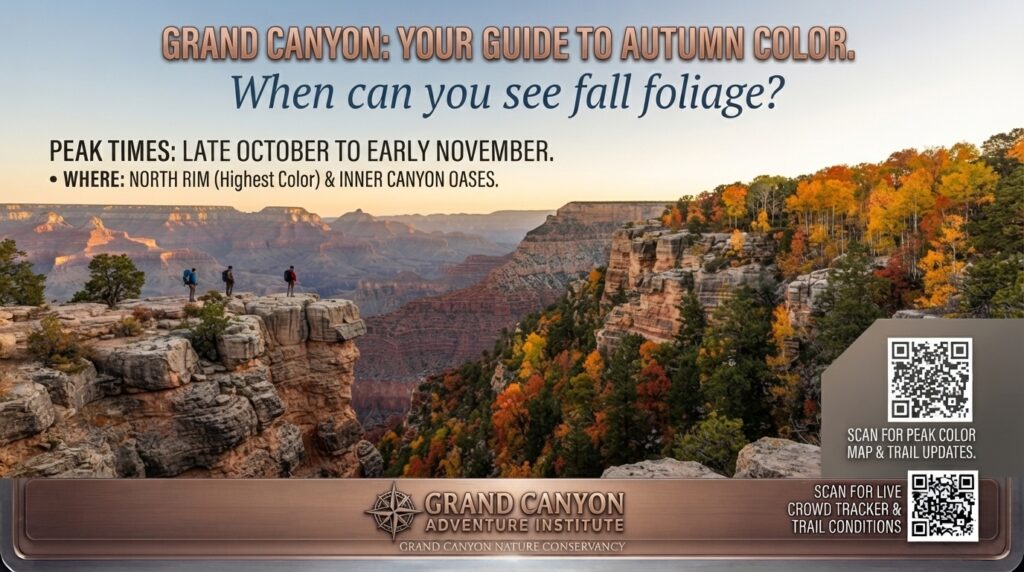
The absolute best time to see peak fall foliage at the Grand Canyon is from late September through mid-October.
Because the park encompasses dramatic elevation shifts—ranging from 8,200 feet at the heavily forested North Rim down to 7,000 feet at the South Rim and 2,400 feet along the Colorado River floor—autumn arrives in distinct waves. The high-altitude North Rim leads the charge with brilliant quaking aspens starting in late September, while the South Rim follows shortly after in early to mid-October with golden Gamble oaks and canyon maples.
This comprehensive guide covers peak foliage timelines, secret leaf-peeping trail locations, autumn climate expectations, gear reviews for high-altitude fall hikes, and 10 detailed FAQs to help you capture peak autumn colors at the Grand Canyon.
The Autumn Foliage Timeline: Elevation & Peak Windows
To catch the foliage at its absolute brightest, you must align your travel dates with the elevation profile of the canyon rim you plan to explore.
                  GRAND CANYON FALL FOLIAGE ELEVATION TIMELINE
                                       │
       ┌───────────────────────────────┼───────────────────────────────┐
       ▼                               ▼                               ▼
[ NORTH RIM (8,200 FT) ]     [ SOUTH RIM (7,000 FT) ]     [ INNER CANYON (2,400 FT) ]
Peak: Sept 25 – Oct 15       Peak: Oct 5 – Oct 25         Peak: Late Oct – Mid Nov
Quaking Aspens, Maples       Gamble Oaks, Willows         Cottonwoods, Desert Willows
       │                               │                               │
       ▼                               ▼                               ▼
Shimmering bright gold &       Warm copper, deep amber,       Golden pockets nestled along
crimson canopy.                and russet orange tones.       the Colorado River corridors.
Grand Canyon Autumn Foliage & Elevation Breakdown
| Canyon Zone | Elevation (Feet) | Primary Foliage Tree Species | Foliage Color Spectrum | Peak Color Window |
| North Rim (High Plateau) | $8,000\text{–}8,800\text{ ft}$ | Quaking Aspen, Rocky Mountain Maple | Electric Gold, Lemon Yellow, Crimson | Sept 25 – Oct 15 (Best Overall) |
| South Rim (Village & Rim) | $6,800\text{–}7,200\text{ ft}$ | Gambel Oak, Bigtooth Maple, Utah Serviceberry | Russet Orange, Amber, Deep Copper | Oct 5 – Oct 25 |
| Canyon Side-Gorges | $4,500\text{–}6,000\text{ ft}$ | Netleaf Hackberry, Arizona Walnut, Boxelder | Golden Yellow, Warm Bronze | Oct 15 – Nov 5 |
| Inner Canyon Floor | $2,400\text{–}3,500\text{ ft}$ | Fremont Cottonwood, Desert Willow | Vibrant Yellow, Honey Amber | Oct 25 – Nov 15 |
Detailed Zone Analysis: Where to Find the Best Colors
1. The North Rim: The Premier Fall Foliage Destination (Late Sept – Mid Oct)
If your primary goal is classic, vibrant fall foliage, the North Rim is undisputed king. Resting more than 1,000 feet higher than the South Rim, the North Rim hosts dense groves of Quaking Aspens (Populus tremuloides) mixed with Engelmann spruce and Douglas fir.
                      NORTH RIM ADVANTAGES VS. TIMING
                                     │
       ┌─────────────────────────────┴─────────────────────────────┐
       ▼                                                           ▼
[ VISUAL SPECTACLE ]                                       [ STRICT CLOSING DEADLINE ]
• Glowing groves of quaking gold aspens              • Vehicle gates close seasonally on Oct 15
• Cool, crisp mountain air (55°F–65°F)               • Commercial services close Oct 15
• 90% fewer crowds than the South Rim                 • Day-use only from Oct 15 until first snow
- Best Foliage Drive: Highway 67 (the Kaibab National Forest Scenic Byway) leading into the park is widely recognized as one of the top autumn scenic drives in North America.
- Top Spot: Point Imperial—the highest point on either rim ($8,803\text{ ft}$)—offers sweeping vistas where bright yellow aspen groves frame red sandstone spires.
2. The South Rim: Subtle Copper & Warm Amber (Early Oct – Late Oct)
While the South Rim is dominated by evergreen Pinyon Pine and Utah Juniper, subtle pockets of autumn color glow throughout October.
- The Gambel Oak Transformation: Gambel Oaks (Quercus gambelii) line the Rim Trail and the upper sections of Bright Angel and South Kaibab trails. In October, their leaves shift to a warm coppery-orange and deep russet brown.
- Hermit Road Canopy: Driving or shuttle-riding along Hermit Road reveals golden cottonwoods and serviceberry bushes contrasting sharply against dark green pines and red canyon walls.
3. The Inner Canyon: Late-Season Oasis (Late Oct – Mid Nov)
By late October, as cold mountain air freezes the rims, autumn warmth descends to the bottom of the canyon.
- Ribbon Falls & Bright Angel Creek: Along Bright Angel Creek and Phantom Ranch ($2,400\text{ ft}$), vast groves of Fremont Cottonwoods (Populus fremontii) turn brilliant honey-yellow between Halloween and mid-November.
- Bonus: Temperatures at the canyon floor fall from blistering summer highs ($105^\circ\text{F}+$) down to a comfortable $75^\circ\text{F}\text{–}80^\circ\text{F}$, creating ideal conditions for rim-to-rim backpacking trips.
Strategic Timing: How to Plan Your Autumn Eco-Trip
  [ SEPT 25 – OCT 5 ]  ──► NORTH RIM EARLY PEAK  ──► Golden aspens, cool air, light traffic.
  [ OCT 6 – OCT 15 ]   ──► ALL-PARK PRIME WINDOW ──► North Rim full gold; South Rim oaks shifting.
  [ OCT 16 – NOV 5 ]   ──► SOUTH & INNER CANYON  ──► South Rim copper oak; inner cottonwoods turn.
- Target the October 1 to October 12 Window: This 12-day window offers the highest probability of catching bright gold aspens on the North Rim alongside emerging amber oaks on the South Rim.
- Book North Rim Lodging Early: The historic Grand Canyon Lodge (North Rim) is the only lodging located inside the North Rim park boundaries. Because services close on October 15, autumn reservations sell out up to 12 months in advance.
- Combine Kaibab National Forest: If park lodging is full, stay in Jacob Lake or Fredonia and explore the endless aspen logging roads across the Kaibab Plateau.
Gear Reviews: Essential Gear for Autumn Canyon Expeditions
Autumn weather at high elevations is notoriously changeable. A morning that starts at a freezing $25^\circ\text{F}$ can easily warm up to $65^\circ\text{F}$ under direct afternoon sun. Layering and reliable optics are essential. Here are four top-rated gear recommendations for fall eco-adventurers:
1. Patagonia R1 Air Full-Zip Hoody
- Best Technical Mid-Layer for Temperature Fluctuations
Made from 100% recycled polyester with a hollow-core fleece weave, the R1 Air delivers exceptional warmth while venting heat during steep uphill hikes.
- Key Specifications:
- Material: 100% Recycled Polyester fleece with zig-zag texture.
- Weight: 12.9 oz ($366\text{ g}$).
- Design: Fitted hood designed to layer easily under windbreakers.
- Pros: Unmatched breathability when hiking steep switchbacks; ultra-soft recycled materials; dries rapidly.
- Cons: High wind permeability (requires a shell layer on breezy rim edges).
2. Nikon Monarch M7 10×42 Binoculars
- Best Optics for Crisp Autumn Valley & Wildlife Viewing
Autumn brings exceptional air clarity to northern Arizona, making high-end optics a must for spotting golden cottonwood groves nestled thousands of feet below on the canyon floor.
- Key Specifications:
- Magnification: $10\times$ with $42\text{mm}$ objective lenses.
- Glass: Extra-low Dispersion (ED) glass with dielectric multi-layer prism coatings.
- Field of View: 367 feet at 1,000 yards.
- Pros: Incredible edge-to-edge sharpness and color accuracy; waterproof and fog-proof casing; wide field of view.
- Cons: Adds $24\text{ oz}$ to your daypack.
3. Black Diamond Trail Ergo Cork Trekking Poles
- Best Ergonomic Stability for Autumn Leaf-Peeping Hikes
Whether navigating loose aspen leaves on the Widforss Trail or descending South Kaibab switchbacks, natural cork grips absorb sweat while providing four points of contact.
- Key Specifications:
- Grip Material: 100% natural ergonomic cork grip.
- Adjustability: Dual FlickLock adjustment system.
- Shaft: 7075 Aluminum tubing.
- Pros: Cork grips conform to hand shape over time; 15-degree corrective angle for comfortable wrist positioning; extremely durable.
- Cons: Slightly heavier than pure carbon fiber poles.
4. Smartwool Classic Thermal Merino Base Layer Crew
- Best Sustainable First-Layer Moisture Management
Crafted from 100% responsibly sourced Merino wool, this base layer keeps you warm during freezing autumn dawns and cool as the sun heats the rim.
- Key Specifications:
- Fabric: 100% Merino Wool ($250\text{ g/m}^2$ interlock knit).
- Seams: Flatlock seam construction minimizes chafing under pack straps.
- Pros: Natural odor resistance (can be worn multiple days on backpacking trips); incredible thermoregulation; itch-free comfort.
- Cons: Requires gentle cycle washing and air drying to prevent shrinkage.
Gear Comparison Matrix for Autumn Leaf-Peepers
| Gear Item | Primary Function | Weight / Spec | Best Used For | Sustainability Rating |
| Patagonia R1 Air | Temperature-Regulating Mid-Layer | 12.9 oz | Active Hiking / Layering | Excellent (100% Recycled) |
| Nikon M7 10×42 | Long-Range Foliage & Wildlife Optics | 24.3 oz | Rim Overlooks & Wildlife | Good (Durable Lifetime) |
| BD Trail Ergo Cork | Joint Stability on Steep Trails | 18.0 oz | Descending Canyon Trails | High (Natural Cork) |
| Smartwool Base Layer | Merino Thermal Moisture Control | 9.7 oz | Freezing Dawns & Nights | Excellent (Sourced Wool) |
Top 4 Hikes for Fall Foliage at the Grand Canyon
  Hike Name                    Location      Distance (RT)   Foliage Highlights
 ────────────────────────────────────────────────────────────────────────────────────────────
  Widforss Trail               North Rim     9.6 Miles       Continuous Quaking Aspen Canopies
  Point Imperial Trail         North Rim     4.0 Miles       High-Altitude Aspens & Canyon Views
  Hermit Road Rim Trail        South Rim     2.8–7.0 Miles   Coppery Gambel Oaks & Serviceberries
  Bright Angel Creek Corridor  Inner Canyon  14.0+ Miles     Golden Fremont Cottonwoods
1. Widforss Trail (North Rim)
- Distance: 9.6 miles round-trip | Difficulty: Moderate
- The Experience: This is hands-down the single best autumn trail in northern Arizona. The path winds along the rim edge, alternating between dense, golden quaking aspen tunnels and jaw-dropping views into Harvey Meadow and Transept Canyon.
2. Point Imperial Trail (North Rim)
- Distance: 4.0 miles round-trip | Difficulty: Easy-Moderate
- The Experience: Starting from the highest point in the park ($8,803\text{ ft}$), this trail traverses burned forest recovery zones where young, vibrant aspens shine against dark evergreens and red sandstone cliffs.
3. Hermit Road Rim Trail (South Rim)
- Distance: 2.8 to 7.0 miles (Flexible) | Difficulty: Easy (Paved/Dirt)
- The Experience: Stroll between Powell Point and The Abyss as Gambel Oaks display deep copper and russet leaves. You can ride the free Hermit Road shuttle bus between viewpoints to customize your distance.
4. North Kaibab Trail to Roaring Springs (North Rim)
- Distance: 9.4 miles round-trip | Difficulty: Strenuous
- The Experience: Descending into Bright Angel Canyon, you drop through distinct ecological zones, moving from golden rim aspens down to canyon maples and stream-side boxelders near Roaring Springs.
5 Practical Eco-Tips for Autumn Visitors
- Check North Rim Seasonal Closing Dates: The North Rim’s commercial facilities (lodge, food, gas) close every year on October 15. Highway 67 remains open for day-use through November 30 (or until the first heavy snowstorm closes the road).
- Drive Safely During Mule Deer & Elk Rutting Season: Autumn is mating season for resident mule deer and massive Rocky Mountain elk. Drive slowly along Park Loop roads, especially at dawn and dusk when animals frequently cross highways.
- Pack Out Micro-Trash: Cold autumn weather slows organic decomposition. Always pack out apple cores, banana peels, and energy bar wrappers.
- Be Prepared for Sudden Snowstorms: At elevations over 8,000 feet, sudden autumn cold fronts can bring unexpected snow flurries in early October. Always carry extra thermal layers, water, and food in your vehicle.
- Leave Fallen Leaves in Place: Resisting the urge to collect pressed aspen leaves or pine cones helps preserve natural nutrients within high-altitude topsoil ecosystems.
Frequently Asked Questions (FAQ)
1. Does the Grand Canyon really have fall foliage?
Yes! While the canyon is famous for red rocks, the high-altitude North Rim ($8,200\text{ ft}$) features massive forests of Quaking Aspens that turn brilliant gold in autumn. The South Rim ($7,000\text{ ft}$) features coppery Gambel Oaks and Bigtooth Maples.
2. What is the single best week to see fall colors at the Grand Canyon?
The ideal window is October 1 through October 10. During this peak week, aspens on the North Rim reach maximum yellow and gold saturation, while South Rim oaks begin displaying warm copper tones.
3. Is the North Rim open in October?
Yes. Full commercial services on the North Rim (lodging, dining, visitors center) operate through October 15. After October 15, the rim remains open for day-use until late November or the season’s first major snowstorm closes Highway 67.
4. Why are the fall colors different between the North Rim and South Rim?
Elevation difference is the primary factor. The North Rim sits more than $1,000\text{ feet}$ higher than the South Rim, allowing cold-tolerant species like Quaking Aspens to thrive. The South Rim is lower and drier, favoring drought-tolerant Gambel Oaks and Serviceberries.
5. Can I see fall colors at the bottom of the Grand Canyon?
Yes! Fremont Cottonwoods along Bright Angel Creek, Phantom Ranch, and Havasu Creek turn bright honey-yellow later in the season—typically between late October and mid-November.
6. What are the temperatures like during autumn at the Grand Canyon?
In October, high temperatures on the rims range from $55^\circ\text{F}$ to $65^\circ\text{F}$ during the day, but drop rapidly to freezing ($28^\circ\text{F}\text{–}35^\circ\text{F}$) at night. In the inner canyon, daytime highs remain pleasant ($75^\circ\text{F}\text{–}85^\circ\text{F}$).
7. Is autumn a busy time to visit the Grand Canyon?
October sees moderate visitation—significantly less than peak summer months (June–August), but higher than quiet winter months (December–February). The North Rim experiences a mini peak in early October as foliage enthusiasts arrive.
8. Do I need special reservations to see fall colors at the Grand Canyon?
No special park entry passes are required beyond the standard National Park entrance fee or your America the Beautiful pass. However, lodging inside the park (especially on the North Rim) must be booked months in advance.
9. What is the best drive for fall foliage near the Grand Canyon?
Arizona Highway 67, which runs $44\text{ miles}$ south from Jacob Lake to the Grand Canyon North Rim through the Kaibab National Forest, is considered one of the top autumn drive routes in the American Southwest.
10. Where can I see crimson and red leaves at the Grand Canyon?
While gold and yellow dominate the landscape, Rocky Mountain Maples and Bigtooth Maples along the upper sections of the North Kaibab Trail and deep side-canyons display bright crimson and deep red foliage in early October.
Conclusion
Seeing fall foliage at the Grand Canyon reveals a softer, more colorful side of Arizona’s famous natural wonder. By timing your visit between late September and mid-October, targeting the high-altitude aspen groves of the North Rim, and gearing up with technical thermal layers, you’ll witness an unforgettable autumn spectacle. Pack your camera, lace up your hiking boots, and head north to catch the canyon at its golden peak.