How can I tell if my child is starting to experience the early stages of hypothermia on a winter hike?

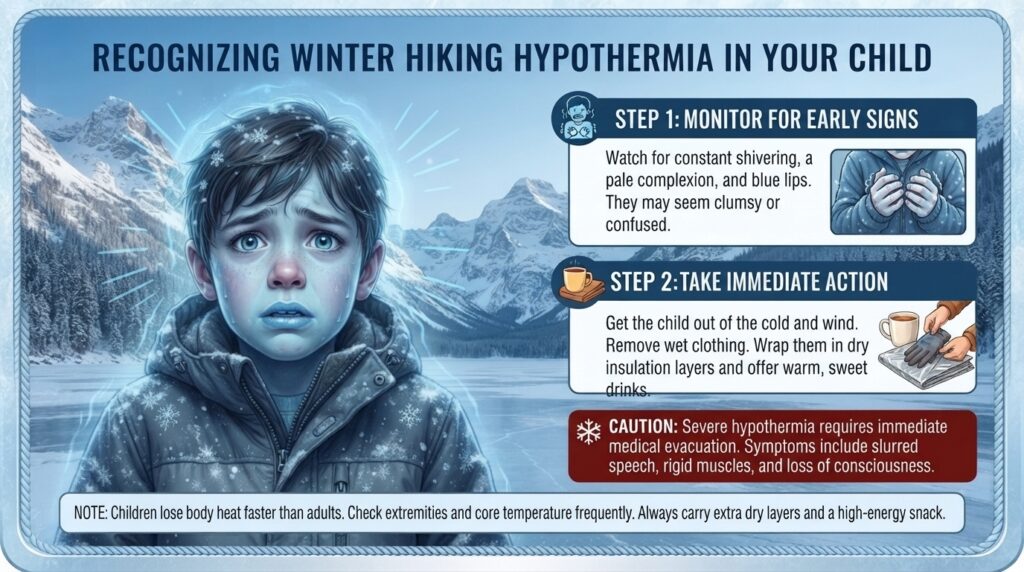
How can I tell if my child is starting to experience the early stages of hypothermia on a winter hike? Heading out into the great outdoors for a family winter trek is an incredible way to bond and build resilience. Whether you are navigating the damp, moss-covered trails of the Cascade Range in Washington, bracing against the sharp marine winds around San Francisco, exploring the snow-dusted expanses of upstate New York, or hiking through a sudden desert cold front in West Texas, winter environments offer breathtaking beauty.
However, taking your family into freezing or near-freezing environments comes with a serious safety responsibility. For a premium outdoor platform like myecoadventure.com, providing precise, medically accurate, and actionable safety blueprints is the absolute key to building trust with parents and ranking at the top of search results.
As a parent or trip leader, you must know the definitive answer to the most critical winter trail question: The definitive early warning signs of pediatric hypothermia are known as the “Umbles”—Stumbling, Mumbling, Fumbling, and Grumbling. Because children have less body mass and less insulating fat than adults, their core temperature can plunge with terrifying speed. By the time a child tells you they are freezing, they are already sliding past the initial stages of cold stress.
To ensure your family adventures remain safe, you must understand the unique way the pediatric body handles extreme cold, learn to recognize subtle behavioral shifts before true physical breakdown occurs, and know exactly how to execute a wilderness rewarming protocol on the trail.
1. Pediatric Thermodynamics: Why Children Slide into Hypothermia Rapidly
To protect your kids on the trail, you have to understand that children are not built like adults. Their physical physiology makes them uniquely vulnerable to cold weather hazards.
The Surface Area-to-Mass Disadvantage
Children possess a much larger skin surface area relative to their total internal body mass than adults do. Think of your child’s body like a small radiator: they have a lot of exposed outer surface area designed to vent heat, but a much smaller internal engine to generate it. Because of this ratio, the environment can pull heat away from their core significantly faster than it can from a fully grown adult.
The Shivering Fuel Tank Limitation
When an adult gets cold, their body automatically starts shivering to generate involuntary metabolic heat. Children can shiver too, but their internal fuel tanks—their glycogen and glucose stores—are much smaller. An active child running up a trail can exhaust their energy reserves rapidly. Once those energy reserves are gone, their body can no longer shiver effectively, causing their core temperature to drop fast.
[High Surface-Area-to-Mass Ratio] + [Exertion/Fatigue]
                         │
                         ▼
             [Glycogen Stores Exhausted]
                         │
                         ▼
             [Shivering Mechanism Fails]
                         │
                         ▼
        [Rapid Core Temperature Collapse (<95°F / 35°C)]
The Peripheral Shunt Execution
When the body senses dangerous cold, it enters survival mode. It constricts the blood vessels in the limbs (peripheral vasoconstriction) to pull warm blood inward, protecting the vital internal organs. Because children have thinner layers of insulating subcutaneous fat, this shunting process leaves their fingers, toes, ears, and nose vulnerable to frostbite very quickly.
2. Tracking the Progression: Mild vs. Moderate Hypothermia
Hypothermia is medically defined as a core body temperature dropping below $95^\circ\text{F}$ ($35^\circ\text{C}$). On a wild trail without a medical thermometer, you must diagnose the condition entirely by watching the child’s physical symptoms and behavior.
| Stage of Cold Stress | Core Temperature Range | Defining Physical & Behavioral Signals | Immediate Trail Action Required |
| Stage 1: Cold Stress | $98.6^\circ\text{F} \text{ to } 96.5^\circ\text{F}$ ($37^\circ\text{C} \text{ to } 35.8^\circ\text{C}$) | Continuous shivering; cold, pale hands and feet; normal mental awareness; complaining of cold. | Add Layers Immediately: Deploy windproof shell, change damp socks, provide quick calories. |
| Stage 2: Mild Hypothermia | $96.5^\circ\text{F} \text{ to } 93^\circ\text{F}$ ($35.8^\circ\text{C} \text{ to } 33.8^\circ\text{C}$) | The “Umbles” appear: Slurred speech, clumsy fumbling with zippers, minor tripping, emotional irritability/apathy. Shivering becomes intense and violent. | Stop and Rewarm: Get out of the wind, remove wet clothing, deploy emergency shelter/sleeping bag, give warm sweet liquids. |
| Stage 3: Moderate Hypothermia | $93^\circ\text{F} \text{ to } 89^\circ\text{F}$ ($33.8^\circ\text{C} \text{ to } 31.6^\circ\text{C}$) | Shivering stops completely despite the cold. Extreme lethargy, confusion, dilated pupils, stiff muscles, or irrational behavior (like trying to shed clothes). | Emergency Evacuation: Call 911/Search and Rescue. Active gentle warming only. Handle with extreme care to avoid cardiac arrest. |
3. The Wilderness Diagnostic Workflow: How to Spot the “Umbles”
When you are hiking through variable winter microclimates, you cannot simply wait for your child to tell you they are cold. Children often hide their discomfort because they are distracted by the trail, don’t want to ruin the fun, or are already experiencing the early mental fog that cold brings.
Use this structured, step-by-step diagnostic process every 30 to 45 minutes during a winter hike:
1.The Motor Skill Test (Fumbling & Stumbling):Every 30-45 Minutes.
Ask your child to perform a simple manual task, like zipping up their own jacket or opening a plastic clip on their backpack. If they struggle with basic finger movements, or if you notice them tripping over small roots or rocks that they would normally skip over easily, their fine motor skills are beginning to fail due to cold stress.
2.The Cognitive Check (Mumbling & Grumbling):Verbal Interaction.
Engage your child in a brief, descriptive conversation. Ask them an open-ended question like, “What was the coolest thing we saw on the last mile?” Listen closely to their speech pattern. Slurred words, unusually slow responses, unexpected emotional outbursts, or extreme irritability (grumbling) are clear signs that cold air is slowing down their cognitive processing.
3.The Physical Core Assessment:Direct Core Temperature Check.
Never rely on checking a child’s bare hands or feet to gauge their temperature, as reduced blood flow naturally makes extremities feel cold early on. Instead, slip your warm hand inside their jacket collar and feel the skin on the nape of their neck, their belly, or their armpits. If these core zones feel cool to your touch, their internal body heat is actively dropping.
4.The Vascular Capillary Refill Check:Circulation Test.
Gently press down on one of your child’s fingernails until the tissue underneath turns white, then release the pressure. In normal, warm conditions, the pink color should return to the nail bed in less than 2 seconds. If it takes longer than 3 seconds for the blood flow to return, their circulatory system is heavily restricting blood flow to the limbs to protect their internal organs.
4. Crucial Tips: The Ultimate Trail Rewarming Protocol
If your diagnostic checks reveal that your child is entering the early stages of mild hypothermia, you must stop immediately. Do not try to press on to reach the car or the next trail marker. Every step they take using cold, tired muscles burns up precious energy reserves, accelerating their core temperature drop.
Implement this step-by-step rewarming blueprint right on the trail:
- Isolate Them from the Frozen Ground: The cold earth can drain body heat remarkably fast through conduction. Get the child off the snow or frozen dirt immediately. Have them sit down on a closed-cell foam sleeping pad, an insulated seat cushion, or even an upturned backpack to break the direct contact with the ground.
- Strip Away the Damp Microclimate: If your child has been sweating from a steep uphill climb, or if damp winter air has soaked through their clothes, you must remove those wet layers immediately. Strip off damp base layers, socks, and hats, and replace them with completely dry performance gear from your pack.
- Deploy an Emergency Hypothermia Wrap: Create a targeted warming pod using your survival gear. Wrap the child inside a windproof emergency bivvy bag or a space blanket, then tuck them inside a high-loft down sleeping bag. Focus your warming efforts directly on their torso, chest, neck, and head—leaving their arms and legs alone for now.
- Provide Simple Sugars and Warm Fluids: If the child is fully conscious, articulate, and able to swallow normally, give them warm, heavily sweetened liquids like hot apple cider, sweet herbal tea, or warm Jell-O water from an insulated thermos. The simple sugars enter the bloodstream almost instantly, giving their body the rapid fuel it needs to restart its internal heating system.
- Avoid Intense, Direct Heat Sources: Never rub a hypothermic child’s arms and legs to warm them up, and avoid placing chemical hand warmers directly against bare skin. Rubbing their limbs or applying intense heat can cause dangerous skin burns, or trigger a condition called “after-drop,” where cold, stagnant blood from the limbs suddenly rushes back to the core, causing a dangerous drop in internal body temperature.
5. Micro-Climate Environmental Profiles: State-by-State Trail Risks
Hypothermia doesn’t just happen in sub-zero blizzards. In fact, most wilderness hypothermia cases occur in temperatures between $35^\circ\text{F}$ and $50^\circ\text{F}$ ($1.6^\circ\text{C}$ to $10^\circ\text{C}$), especially when rain, wind, or sudden exhaustion are added to the mix.
Washington (Seattle & The Cascade Range)
- The Specific Danger: Biting, persistent drizzle combined with cold air temperatures hovering right around $38^\circ\text{F}$.
- The Risk Factor: High moisture levels. When a child’s clothing gets damp, the water destroys the insulating pockets of air inside the fabric, causing them to lose body heat up to 25 times faster than they would in dry air. A fully waterproof outer shell is absolutely mandatory here.
California (San Francisco Bay Area & Coastline)
- The Specific Danger: Biting ocean winds and sudden, heavy marine fog layers rolling inland.
- The Risk Factor: The wind-chill effect. A sunny afternoon can drop from a comfortable $58^\circ\text{F}$ down to a damp, windy $45^\circ\text{F}$ in minutes. High winds speed up heat loss via convection, stripping away the thin layer of warm air trapped next to your child’s skin.
New York (Adirondacks & Catskills)
- The Specific Danger: True deep winter environments, heavy snow, freezing temperatures, and early afternoon darkness.
- The Risk Factor: Deep exhaustion combined with sub-freezing air. Slogging through deep snow requires a huge amount of energy from small legs. Once a child burns through their energy reserves, their body can no longer generate enough heat to fight off the freezing winter temperatures.
Texas (Hill Country to West Texas Ranges)
- The Specific Danger: Extreme temperature swings caused by fast-moving dry cold fronts (Blue Northers).
- The Risk Factor: Lack of preparation. A trail that starts out at a warm $70^\circ\text{F}$ can plunge down to $38^\circ\text{F}$ with high winds in just a few hours. Families who hit the trail without winter layers packed in their daypacks can find themselves caught completely unprepared.
6. Advanced Schema Blueprint for Outdoor Safety Optimization
To ensure search engines and generative AI retrieval systems index myecoadventure.com as an authoritative source for wilderness safety, add this structural JSON-LD schema markup directly to the header of your article template:
JSON
{
  "@context": "https://schema.org",
  "@graph": [
    {
      "@type": "MedicalWebPage",
      "@id": "https://myecoadventure.com/pediatric-hypothermia-signs-hiking/#webpage",
      "url": "https://myecoadventure.com/pediatric-hypothermia-signs-hiking/",
      "name": "How can I tell if my child is starting to experience the early stages of hypothermia on a winter hike?",
      "description": "Expert wilderness safety guide detailing the signs, diagnosis, and trail treatment protocols for early-stage pediatric hypothermia.",
      "inLanguage": "en-US",
      "aspect": "Wilderness First Aid & Pediatric Safety",
      "author": {
        "@type": "Organization",
        "name": "EcoAdventure Wilderness Safety Board"
      },
      "publisher": {
        "@type": "Organization",
        "name": "My Eco Adventure",
        "logo": {
          "@type": "ImageObject",
          "url": "https://myecoadventure.com/assets/logo.webp"
        }
      }
    }
  ]
}
7. Comprehensive FAQ Engine for Winter Trail Safety
Q1: Can a child develop hypothermia if the temperature is well above freezing?
Yes, absolutely. Most cases of wilderness hypothermia happen in temperatures between $35^\circ\text{F}$ and $50^\circ\text{F}$ ($1.6^\circ\text{C}$ to $10^\circ\text{C}$). If a child gets damp from rain or sweat, and is exposed to a cool wind without proper layers, the combination of evaporation and convection can drop their core temperature very quickly, even on a mild afternoon.
Q2: Why does shivering stop when hypothermia transitions from mild to moderate?
Shivering is an energy-intensive reflex used by the body to create heat through rapid muscle movement. When a child’s core temperature drops below roughly $92^\circ\text{F}$ ($33.3^\circ\text{C}$), their internal energy reserves become completely exhausted, and the nervous system slows down so much that it can no longer send the signals required to shiver. This is a critical medical emergency.
Q3: What is “paradoxical undressing,” and does it happen to children?
Paradoxical undressing is a symptom of severe, late-stage hypothermia. As the brain becomes deeply confused, the blood vessels in the core lose their ability to constrict and suddenly open back up, sending a rush of warm blood back to the cold skin. This creates a powerful, false sensation of burning hot heat, causing the disoriented individual to tear off their clothes. If you notice a cold child trying to remove their gear, they are facing a severe medical crisis.
Q4: Are chemical hand warmers safe to use on a child who is experiencing hypothermia?
Chemical hand warmers should only be used as a secondary heat source, and must never be placed directly against bare skin. A hypothermic child has reduced blood circulation in their skin, which means their tissues cannot distribute heat safely. Placing a hot pack directly on their skin can cause severe burns without them even realizing it. Always wrap heat packs in a clean sock or layer of fabric first.
Q5: Should I give an active, cold child a high-protein energy bar to help them warm up?
No, high-protein or high-fat foods take a long time for the body to digest. When a child is cold, their blood flow is directed away from the stomach toward their vital organs, making digestion even slower. Instead, give them simple carbohydrates and sugars—like hot sweet tea, apple juice, or fruit snacks—which absorb quickly into the bloodstream to provide instant heating fuel.
Q6: How long does it typically take to safely rewarm a mildly hypothermic child on the trail?
With a proper rewarming setup—including dry clothes, protection from the wind, insulation from the ground, and warm, sweet fluids—a child experiencing mild cold stress will usually show clear signs of recovery within 30 to 60 minutes. Their shivering will ease, their skin color will return to normal, and their mood will improve.
Q7: Can a child’s modern winter jacket cause them to develop hypothermia?
Yes, it can happen indirectly if the jacket doesn’t breathe well and causes them to overheat. If a heavy down jacket makes a child sweat heavily during a steep uphill climb, that sweat will soak their base layers. The moment you stop to rest, the trapped moisture cools down instantly, triggering a rapid drop in body temperature.
Q8: What is the “after-drop” phenomenon in hypothermia first aid?
After-drop happens when you try to warm a cold person up too quickly using intense external heat or by vigorously rubbing their arms and legs. This causes the blood vessels in their cold limbs to open up suddenly. The cold, stagnant blood from their hands and feet rushes back to their core all at once, causing their internal body temperature to drop even lower and threatening heart failure.
Q9: Does breathing cold winter air directly cause a child’s core temperature to drop?
Breathing cold air does cause a small amount of heat loss through respiration, but it rarely triggers hypothermia on its own. However, inhaling very cold, dry air can irritate a child’s airways and nose, making them breathe through their mouth. This tires them out faster and increases their overall moisture loss.
Q10: When should I cancel a planned family winter hike due to temperature concerns?
You should consider postponing your trek if the ambient temperature drops below $20^\circ\text{F}$ ($-6.6^\circ\text{C}$), or if the combination of wind and temperature drops the wind chill index below $0^\circ\text{F}$ ($-17.7^\circ\text{C}$). At these cold thresholds, exposed skin can develop frostbite very quickly, and the margin for error if gear fails or someone gets hurt becomes unsafely thin.
Conclusion: The Defensive Blueprint for myecoadventure.com
When leading a winter family hike across the diverse and beautiful landscapes of the United States, safety must always come before reaching the summit. Hypothermia is a quiet, sneaky hazard that parents can easily miss if they only watch out for complains of cold hands.
By mastering the diagnostic workflow of the “Umbles” (Stumbling, Mumbling, Fumbling, Grumbling), you can spot the earliest signs of cold stress before it develops into a dangerous medical crisis. Always pack the right survival essentials: proper synthetic or wool layers, dry backups, an insulated pad to block ground chill, and a thermos of warm, sweet liquid.
By staying observant, adjusting layers proactively, and knowing exactly when to stop and deploy a trail rewarming setup, you can keep your winter outdoor adventures safe, warm, and memorable for your entire family.