How long does it take to hike to the bottom of the Grand Canyon and back in one day?

How long does it take to hike to the bottom of the Grand Canyon and back in one day? For outdoor enthusiasts planning an epic getaway—whether traveling from the bustling tech hubs of San Francisco and Seattle, the urban density of New York, the sun-baked expanses of Texas, or the vibrant landscapes of California and Washington—the Grand Canyon stands as a bucket-list titan. Standing at the rim, peering over the edge into the dizzying, multicolored abyss, a common question echoes among visitors:
“How long does it actually take to hike down to the Colorado River and back up in a single day?”
The short, blunt answer delivered by veteran park rangers is: Between 12 to 15 hours, if you are fortunate, physically elite, and extremely lucky.
More importantly, the National Park Service strongly discourages attempting this feat in a single day. Yet, thousands of eager hikers try it every year, vastly underestimating the time commitment, the brutal inverted topography, and the ticking clock of natural sunlight and desert heat. In this comprehensive, deep-dive guide, we dissect the exact timelines, pacing realities, logistical hurdles, and gear requirements needed to understand what a rim-to-river-to-rim (R2R) day hike truly demands.
1. The Raw Math: Distance and Elevation Timelines
To answer how long the journey takes, you must look closely at the numbers behind the two most popular corridor trails connecting the South Rim to the Colorado River: the Bright Angel Trail and the South Kaibab Trail.
Route Breakdowns & Estimated Hours
| Trail Route | Total Mileage (Round Trip) | Vertical Descent & Ascent | Average Completion Time | Realistic Time Window |
| South Kaibab Trail (Direct, Exposed) | ~14 to 15 miles | ~4,860 feet | 9 to 11 hours (Moving Time) | 11 to 14 hours (Total Elapsed) |
| Bright Angel Trail (Gradual, Water Stations) | ~19 miles | ~4,460 feet | 11 to 13 hours (Moving Time) | 13 to 16 hours (Total Elapsed) |
| Rim-to-River-to-Rim Loop (Kaibab Down, Bright Angel Up) | ~16.5 to 17 miles | ~4,860 feet | 10 to 12 hours (Moving Time) | 12 to 15 hours (Total Elapsed) |
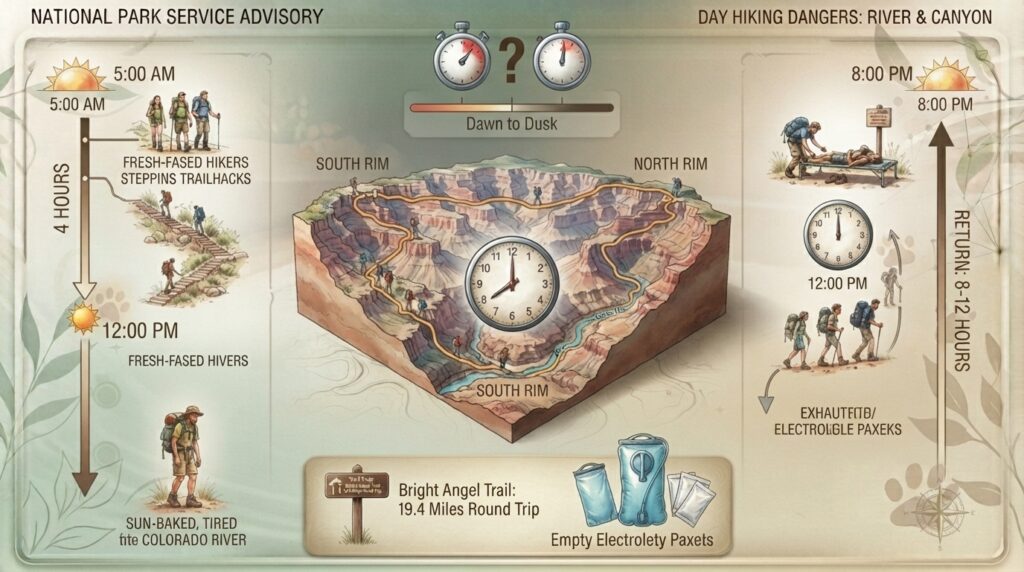
+-----------------------------------------------------------------------------------+
|                     TYPICAL RIM-TO-RIVER TIMELINE BREAKDOWN                       |
+-----------------------------------------------------------------------------------+
|  [04:30 AM] - Headlamp On: Begin descent down South Kaibab Trail in pitch black   |
|  [08:30 AM] - Arrive at the Colorado River (Phantom Ranch / Bright Angel Camp)     |
|  [09:00 AM] - Rest, rehydrate, and fuel up before the midday heat trap            |
|  [09:30 AM] - Begin the grueling 6-hour vertical climb back up to the South Rim   |
|  [03:30 PM] - Battle extreme afternoon heat through exposed switchbacks            |
|  [07:30 PM] - Sunset arrival back at the rim (Total time: ~15 exhausting hours)    |
+-----------------------------------------------------------------------------------+
The Downhill Trap: Why Going Down Isn’t Faster
Many novice hikers assume that because gravity pulls you downward, the descent will take a fraction of the time. While your downward speed may initially be fast (2.5 to 3 miles per hour), the relentless pounding on your knees, quads, and toes takes a massive biomechanical toll. Furthermore, rushing down the upper switchbacks often leads to severe muscle fatigue before you even reach the halfway point.
2. Breaking Down the Hours: Phase-by-Phase Analysis
To truly grasp why a one-day trek takes upwards of 15 hours, let us break down a standard timeline from dawn until dusk.
Phase 1: The Predawn Descent (4:30 AM – 8:30 AM)
- The Environment: Cold, crisp, and dark. Hikers start with headlamps, navigating loose gravel and steep, descending stone steps.
- The Pace: Fast and energized.
- The Danger: Ankle rolls on unseen rocks and burning through energy too quickly.
Phase 2: The River Floor Turnaround (8:30 AM – 9:30 AM)
- The Environment: Blazing sunlight hitting the inner gorge, temperatures rising rapidly.
- The Pace: Halted. You reach the Colorado River, cross the Silver Bridge or Black Bridge, and pause at Phantom Ranch or Bright Angel Campground.
- The Danger: A false sense of security. Hikers look up at the rim and think, “That doesn’t look too far away.”
Phase 3: The Ascent Through the Furnace (9:30 AM – 3:30 PM)
- The Environment: Peak solar radiation. Temperatures in the inner canyon routinely spike past 105°F to 115°F during summer months.
- The Pace: Snail’s pace. What felt like a steady 3 mph walk on flat ground drops to 1 to 1.5 mph as you vertical climb against gravity.
- The Danger: Heat exhaustion, heat stroke, severe electrolyte depletion, and complete water exhaustion.
Phase 4: The Final Push to the Rim (3:30 PM – 7:30 PM)
- The Environment: Shadows lengthening, but core body exhaustion peaking. Legs are heavy, shoulders ache from heavy water packs, and mental fatigue sets in.
- The Pace: Grueling determination. Every switchback looks identical.
- The Danger: Misjudging daylight, running out of headlamp batteries, and emergency search-and-rescue activation.
3. Physiological Realities: Why Time Equals Stress on the Body
Time spent in the Grand Canyon is directly proportional to metabolic and cardiovascular stress. When you subject your body to 12+ hours of continuous aerobic exertion in high heat, several physiological bottlenecks occur:
- Glycogen Depletion: Your body stores limited carbohydrates in your muscles and liver. Without continuous caloric intake (eating 200–300 calories every hour), you will hit “the wall”—a state of acute physical and mental exhaustion.
- Electrolyte Washout: Sweating removes sodium and potassium. Drinking massive quantities of plain water without replacing these electrolytes leads to hyponatremia—a condition where blood sodium drops to dangerously low levels, causing confusion, seizures, and swelling.
- Eccentric Muscle Damage: Walking uphill requires concentric muscle contraction, but walking downhill requires eccentric contraction (muscles lengthening under load). This micro-tears muscle fibers, causing severe delayed onset muscle soreness (DOMS) and profound structural weakness.
4. Essential Gear and Equipment for Endurance Canyon Hiking
Succeeding in a massive single-day canyon expedition—or safely completing shorter, rigorous national park hikes—requires high-performance technical gear. Below is a curated review table of top-tier equipment designed for extreme terrain.
High-Performance Gear Comparison Table
| Product Category | Recommended Model / Item | Key Performance Metrics | Ideal Use Case |
| Endurance Daypack | Osprey Talon 22 / Tempest 20 | AirScape backpanel, BioStretch harness, 22L capacity. | Carrying 4L of water, safety layers, and food without back strain. |
| Technical Trail Footwear | Hoka Speedgoat 5 | Vibram Megagrip, plush CMEVA foam midsole, deep lugs. | Maximum cushioning and shock absorption on 15+ miles of rock. |
| Stability Poles | Leki Makalu Lite AS | Aergon Air grip, Dynamic Suspension System, aluminum shaft. | Mitigating knee impact during 6,000 feet of descent. |
| Water Filtration | Katadyn BeFree 1.0L Filter | Hollow fiber 0.1 micron, ultra-fast 2L/min flow rate. | Emergency field filtration at trailside water spigots/creeks. |
| Headlamp | Petzl Actik Core | 600 lumens, rechargeable CORE battery, red lighting mode. | Navigating the predawn 4:30 AM trail start safely. |
5. Product Reviews: Field-Testing Gear for Extreme Endurance Hikes
To help you prepare your gear checklist for your next major national park excursion, our team field-tested three standout products built for high-mileage, rugged terrain.
1. Hoka Speedgoat 5 Trail Running Shoes
- Overview: A cult-favorite trail shoe known for its oversized foam midsole and aggressive traction designed to eat up technical terrain.
- Performance: When you are 10 hours deep into a grueling hike, foot fatigue is your worst enemy. The plush cushioning of the Speedgoat 5 absorbed the relentless shock of sharp limestone and granite steps, while the Vibram Megagrip outsole kept footing secure on loose gravel switchbacks.
- Pros: Exceptional impact cushioning, phenomenal grip on dry and dusty rock, lightweight design reduces leg swing fatigue.
- Cons: Narrow toe box can feel snug for hikers with wider feet; softer foam wears down faster on abrasive rock surfaces.
- Rating: 4.9 / 5 Stars
2. Leki Makalu Lite AS Anti-Shock Trekking Poles
- Overview: A lightweight, highly durable aluminum pole featuring integrated anti-shock spring systems to dampen vibration.
- Performance: Descending thousands of feet punishes your patellar tendons. The Makalu Lite poles acted as shock absorbers, noticeably reducing the jarring impact on joints. The ergonomic grip prevented hand chafing during hours of gripping pressure.
- Pros: Reliable SpeedLock plus adjustment system, effective vibration dampening, comfortable wrist straps.
- Cons: Twist-free locking mechanism requires periodic tightening in dusty environments.
- Rating: 4.8 / 5 Stars
3. Petzl Actik Core Headlamp
- Overview: A compact, USB-rechargeable hybrid headlamp pumping out up to 600 lumens with wide and mixed beam patterns.
- Performance: Starting a pre-dawn canyon hike requires reliable, bright illumination to spot trail edges and loose scree. The Actik Core provided brilliant peripheral light, and its dual power compatibility (accepting AAA batteries as a backup) offered peace of mind in remote areas.
- Pros: Incredibly bright for its size, rechargeable via micro-USB, lightweight and comfortable headband.
- Cons: Button can be slightly difficult to press when wearing thick winter or liner gloves.
- Rating: 4.7 / 5 Stars
6. Expert Tips for Time Management and Survival on Long Hikes
When tackling massive elevation profiles in extreme environments, time management is just as crucial as physical fitness. Implement these professional guidelines:
- Strict Turnaround Times: Set an uncompromising turnaround hour (e.g., 11:00 AM) before your hike begins. If you have not reached the river by that precise moment, turn around immediately. Trying to climb out in the dark or late afternoon heat multiplies emergency risks.
- The “One Liter Per Hour” Rule: Drink one liter of cool water every single hour you are active below the rim. Never wait until you feel thirsty, as thirst is an indicator that dehydration has already begun.
- Micro-Feed Every 45 Minutes: Do not rely on three large meals. Graze continuously on high-sodium snacks, electrolyte chews, nuts, and energy bars to maintain stable blood sugar levels throughout the 15-hour ordeal.
- Check Pipeline and Water Status Daily: Never assume park water spigots are working. Pipeline breaks occur frequently in inner canyons. Always check official visitor center updates and carry backup chemical purification tablets or filters.
- Pack a Personal Emergency Bivy: If unexpected exhaustion or injury delays your ascent and forces you to spend hours waiting out the night in the canyon, a lightweight emergency bivy sack can prevent hypothermia as temperatures plummet after sunset.
7. Frequently Asked Questions (FAQs)
1. Is it physically possible for an average person to hike to the river and back in one day?
While physically possible for someone with exceptional endurance, it is strongly discouraged for average hikers. Most unprepared individuals who attempt it experience severe heat exhaustion, extreme dehydration, or injury, requiring costly and dangerous search-and-rescue extractions.
2. What time should a rim-to-river day hike begin?
To beat the brutal midday heat and ensure you have enough daylight to complete the 12-to-15-hour journey, hikers must start well before dawn—typically between 4:00 AM and 4:30 AM using reliable headlamps.
3. Which trail is faster for a day hike: South Kaibab or Bright Angel?
South Kaibab is shorter in distance (~14 miles round trip) and faster to descend, but it has zero shade and no water sources. Bright Angel is longer (~19 miles round trip) but offers seasonal water stations and shade corridors. Many hikers descend South Kaibab and ascend Bright Angel.
4. How much total weight will my daypack need to hold?
To carry the necessary 4 to 6 liters of water, emergency layers, first-aid kit, headlamp, and high-calorie food, your pack will weigh between 12 to 18 pounds. Training with this weighted pack beforehand is essential.
5. What are the warning signs that I should turn back immediately?
Warning signs include severe persistent headaches, dizziness, confusion, nausea, muscle cramping, dark amber urine, cessation of sweating, or feeling unusually apathetic. These indicate heat illness and require immediate rest in shade and rehydration.
6. Do I need a permit from the National Park Service for a day hike?
Standard corridor day hiking on the South Kaibab and Bright Angel trails does not require a backcountry permit. However, overnight camping, mule trips, or specialized group events do require formal permits and reservations.
7. Can I filter water from the Colorado River or Bright Angel Creek?
You can filter water from designated potable spigots or treated natural sources when available. Pumping directly from the silt-heavy Colorado River will clog standard microfilters instantly; if using natural water, it must settle first before heavy filtration and chemical purification.
8. What kind of footwear is best for a 15-hour canyon hike?
Trail running shoes with sticky rubber outsoles and robust cushioning (like Hoka or Salomon) are preferred by modern hikers over heavy leather hiking boots because they reduce overall foot fatigue and dry out faster.
9. How do park rangers rescue stranded day hikers?
Rescuers utilize foot patrols, pack mules, and—when weather, wind, and high inner-canyon temperatures permit—search-and-rescue helicopters. Because helicopter rescues are severely restricted by high ambient heat and downdrafts, self-reliance is mandatory.
10. Are there alternative ways to see the river without hiking 15 hours?
Yes. You can book mule rides partway down, take guided whitewater rafting trips on the Colorado River, or hike safely to intermediate viewpoints like O’Neogah Point (South Kaibab) or Indian Garden / 1.5-Mile Resthouse (Bright Angel) and return safely in 3 to 5 hours.
Conclusion: Respect the Clock and the Canyon
So, how long does it take to hike to the bottom of the Grand Canyon and back in one day? 12 to 15 hours of grueling, relentless physical effort.
It is an undertaking that tests the limits of human endurance, cardiovascular stamina, and mental fortitude. By understanding the timeline realities, respecting the punishing microclimate of the inner gorge, and equipping yourself with high-performance gear, you ensure that your national park expedition remains an inspiring triumph rather than an emergency extraction statistic. Plan thoroughly, watch the clock, and always know when it is time to turn around.