
Do I need a permit to day hike to the bottom of the Grand Canyon? For outdoor enthusiasts planning an epic escape—whether driving in from the sun-drenched regions of Texas, flying out from urban hubs like New York, San Francisco, and Seattle, or traveling from across California and Washington—the Grand Canyon stands as an ultimate bucket-list destination.
Standing at the rim, looking down over a vertical mile of carved stone to where the Colorado River glints in the sunlight, a common point of confusion arises for independent travelers:
“Do I need a permit from the National Park Service just to hike down to the river and back in a single day?”
The short, straightforward answer is no. For standard individual or small-group day hikers, no backcountry permit is required by the National Park Service (NPS) to hike from the rim to the river and back, provided you complete the entire journey within a single calendar day.
However, “no permit required” does not mean “no rules.” In this comprehensive guide, we unpack the precise legal boundaries, the hidden caveats regarding group sizes, the differences between day hiking and overnight backpacking, and the essential gear required to survive this punishing 15-hour trek safely.
1. The Core Rule: Day Hikes vs. Overnight Backcountry Permits
To understand how Grand Canyon National Park manages trail traffic, it is vital to distinguish between a day hike and an overnight excursion.
The National Park Service Regulations Matrix
| Hiking Type | Permit Required? | How to Obtain / Requirements |
| Standard Day Hike (Rim-to-River-to-Rim in one day) | No | None required for individuals or small private groups. Must exit the canyon before nightfall. |
| Overnight Backpacking (Camping below the rim) | Yes | Requires an advance Backcountry Permit via Recreation.gov (subject to lottery or availability). |
| Phantom Ranch Stay (Overnight cabin/dorm) | Yes | Requires booking via Xanterra/Grand Canyon Lodges (often via a 15-month advance lottery system). |
| Organized / Large Group Day Hikes | Yes (Special Use Permit) | Required if a non-commercial group has between 12 to 30 participants completing inner-canyon routes. |
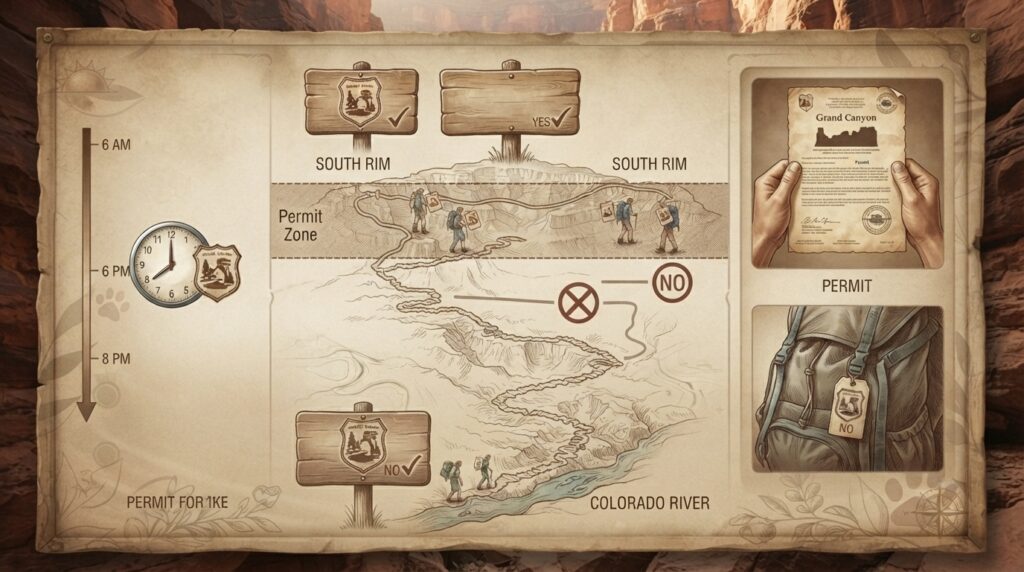
+-----------------------------------------------------------------------+
|                    THE PERMIT DECISION TREE                           |
+-----------------------------------------------------------------------+
| Are you sleeping below the rim?                                       |
|   ├── YES ---> You MUST secure a Backcountry Permit / Reservation.    |
|   └── NO  ---> Are you part of a large group (12–30 people)?          |
|                 ├── YES ---> You need a Special Use Permit (SUP).  |
|                 └── NO  ---> No permit needed! Hike freely, but       |
|                              respect park safety rules.               |
+-----------------------------------------------------------------------+
2. The Exception That Catches People Off Guard: Large Group Permits
While a solo hiker, a couple, or a small family of four can walk down the Bright Angel or South Kaibab trails to the river without paperwork, large groups face strict oversight.
According to the National Park Service:
- Any organized, non-commercial group consisting of 12 to 30 participants conducting rim-to-rim, rim-to-river-to-rim, or extended inner-canyon day hikes must obtain a Special Use Permit (SUP).
- The inner canyon is officially defined by the NPS as the area below the Tonto Platform from the South Rim and below Manzanita Resthouse from the North Rim.
- No loophole splitting: Groups are legally prohibited from breaking into smaller clusters on separate unofficial “day hikes” to bypass the 12-person threshold.
Failing to secure a Special Use Permit for a large organized club or student group can result in heavy fines and trail ejection by park rangers.
3. Why No Permit Doesn’t Mean “Easy”: The Realities of Day Hiking
Because the NPS does not gatekeep single-day descents with a permit lottery, many visitors mistakenly assume a rim-to-river day hike is a casual recreational walk. In reality, it is an extreme endurance test that spans roughly 14 to 19 miles with nearly 6,000 feet of cumulative vertical elevation change.
The Ticking Clock
Without a permit forcing you to check into a designated campground, your biggest enemy is time. Completing a round-trip journey to the Colorado River and back requires:
- Starting in Pitch Darkness: Most successful day hikers begin between 4:00 AM and 4:30 AM with high-powered headlamps.
- Battling the Midday Furnace: You will be climbing out of the canyon floor during peak afternoon hours when inner-gorge temperatures regularly exceed 105°F to 115°F (41°C to 46°C).
- Beating the Sunset: Failing to reach the rim before dark means navigating sheer cliff edges with failing headlamp batteries—a recipe for catastrophic injury.
4. Essential Gear and Equipment for Permit-Free Canyon Treks
Because you won’t be staying overnight, you must carry everything required to sustain your body through 12 to 15 hours of continuous physical stress in a single pack. Below is a curated review table of top-tier equipment designed for extreme desert day hikes.
High-Performance Gear Comparison Table
| Product Category | Recommended Model / Item | Key Performance Metrics | Ideal Use Case |
| Endurance Daypack | Osprey Talon 22 / Tempest 20 | AirScape backpanel, BioStretch harness, 22L capacity. | Carrying 4L of water, safety layers, and food without back strain. |
| Technical Trail Footwear | Hoka Speedgoat 5 | Vibram Megagrip, plush CMEVA foam midsole, deep lugs. | Maximum cushioning and shock absorption on 15+ miles of rock. |
| Stability Poles | Leki Makalu Lite AS | Aergon Air grip, Dynamic Suspension System, aluminum shaft. | Mitigating knee impact during 6,000 feet of descent. |
| Water Filtration | Katadyn BeFree 1.0L Filter | Hollow fiber 0.1 micron, ultra-fast 2L/min flow rate. | Emergency field filtration at trailside water spigots/creeks. |
| Headlamp | Petzl Actik Core | 600 lumens, rechargeable CORE battery, red lighting mode. | Navigating the predawn 4:30 AM trail start safely. |
5. Product Reviews: Field-Testing Gear for Long Canyon Day Hikes
To help you prepare your gear checklist for your next major national park excursion, our team field-tested three standout products built for high-mileage, rugged terrain.
1. Hoka Speedgoat 5 Trail Running Shoes
- Overview: A cult-favorite trail shoe known for its oversized foam midsole and aggressive traction designed to eat up technical terrain.
- Performance: When you are 10 hours deep into a grueling hike, foot fatigue is your worst enemy. The plush cushioning of the Speedgoat 5 absorbed the relentless shock of sharp limestone and granite steps, while the Vibram Megagrip outsole kept footing secure on loose gravel switchbacks.
- Pros: Exceptional impact cushioning, phenomenal grip on dry and dusty rock, lightweight design reduces leg swing fatigue.
- Cons: Narrow toe box can feel snug for hikers with wider feet; softer foam wears down faster on abrasive rock surfaces.
- Rating: 4.9 / 5 Stars
2. Leki Makalu Lite AS Anti-Shock Trekking Poles
- Overview: A lightweight, highly durable aluminum pole featuring integrated anti-shock spring systems to dampen vibration.
- Performance: Descending thousands of feet punishes your patellar tendons. The Makalu Lite poles acted as shock absorbers, noticeably reducing the jarring impact on joints. The ergonomic grip prevented hand chafing during hours of gripping pressure.
- Pros: Reliable SpeedLock plus adjustment system, effective vibration dampening, comfortable wrist straps.
- Cons: Twist-free locking mechanism requires periodic tightening in dusty environments.
- Rating: 4.8 / 5 Stars
3. Petzl Actik Core Headlamp
- Overview: A compact, USB-rechargeable hybrid headlamp pumping out up to 600 lumens with wide and mixed beam patterns.
- Performance: Starting a pre-dawn canyon hike requires reliable, bright illumination to spot trail edges and loose scree. The Actik Core provided brilliant peripheral light, and its dual power compatibility (accepting AAA batteries as a backup) offered peace of mind in remote areas.
- Pros: Incredibly bright for its size, rechargeable via micro-USB, lightweight and comfortable headband.
- Cons: Button can be slightly difficult to press when wearing thick winter or liner gloves.
- Rating: 4.7 / 5 Stars
6. Expert Tips for Navigating Grand Canyon Regulations and Safety
Even though day hikers bypass the complicated backcountry permit lottery, you must respect park infrastructure and environmental laws:
- Adhere to Leave No Trace (LNT): Pack out every crumb of trash, fruit peel, and wrapper. Never carve into sandstone walls or disturb local wildlife (such as bighorn sheep and California condors).
- Verify Water Station Status Daily: The park maintains seasonal water pipelines along Bright Angel and South Kaibab trails, but pipe breaks are common. Never rely blindly on spigots; always pack backup chemical purification tablets or a microfilter.
- Monitor Urine Output and Color: In extreme heat, dehydration strikes silently. Clear or pale-yellow urine indicates proper hydration; dark amber urine signals an impending medical emergency.
- Set an Uncompromising Turnaround Time: Set your hard turnaround time (e.g., 11:00 AM) before setting foot on the trail. If you haven’t reached the river by that hour, turn around immediately to avoid climbing out in the dark or lethal heat.
- Pay Your Park Entrance Fee: While day hiking trails don’t require permits, entering Grand Canyon National Park requires a standard vehicle, pedestrian, or America the Beautiful interagency pass.
7. Frequently Asked Questions (FAQs)
1. Do I need a permit if I hike from the South Rim to the North Rim in one day?
No. A single-day rim-to-rim (R2R) or rim-to-rim-to-rim (R2R2R) hike does not require a backcountry permit, as long as you complete the entire trek within one calendar day without camping.
2. What happens if I get too tired and have to sleep overnight without a permit?
Attempting to camp overnight without a valid backcountry permit is illegal and subject to citations, fines, and escort off the trail. Furthermore, park rangers routinely check trails and camps; unprepared illegal campers strain emergency resources.
3. Can I camp at Phantom Ranch overnight if I day-hiked down?
No. Phantom Ranch lodging and cabins must be booked over a year in advance via lottery. You cannot show up as a day hiker and rent a cabin or dorm bed on a whim.
4. Are dogs allowed on inner-canyon day hikes?
No. Pets are strictly prohibited below the rim on all inner-canyon trails (including Bright Angel and South Kaibab) due to extreme temperatures, lack of water, and dangerous wildlife encounters. Pets are only allowed on upper rim trails (like the Rim Trail).
5. How many people can be in a day-hiking group before a permit is mandatory?
Any non-commercial, organized group exceeding 11 participants (meaning 12 to 30 people) requires an official Special Use Permit (SUP) from the National Park Service.
6. Do I need a permit to day hike during the winter months?
No permits are required for day hiking in winter, but winter hikers face entirely different hazards—such as packed ice, snowstorms, and freezing temperatures on upper switchbacks—requiring traction devices like microspikes.
7. Are park entrance fees required if I am just day hiking?
Yes. Entering Grand Canyon National Park requires purchasing an admission pass at the gate or online via Recreation.gov, unless you hold a valid annual interagency pass.
8. How much water should I carry since I won’t have a backcountry campsite?
The National Park Service recommends carrying and consuming one liter of water per hour of active hiking. For a 12-to-15-hour day hike, you will need to plan water refill logistics or carry 4 to 6 liters of water.
9. What are the consequences of hiking without a required group permit?
If an organized group of 12 or more people conducts an inner-canyon day hike without a Special Use Permit, organizers face federal fines, citations, and potential bans from national park lands.
10. Where can I check official trail closures and water statuses?
Always check the official National Park Service Grand Canyon “Backcountry Updates and Closures” webpage or speak directly with rangers at the Backcountry Information Center before starting your hike.
Conclusion: Freedom with Responsibility
The absence of a permit requirement for single-day Grand Canyon descents offers incredible freedom for adventurous travelers. You can wake up, check the weather, lace up your boots, and tackle one of the most magnificent geological wonders on earth.
However, freedom comes with absolute personal responsibility. Without a permit system regulating your timeline, you are entirely responsible for your safety, hydration, pacing, and survival. Respect the canyon’s brutal mathematical and thermal realities, pack heavy on water, respect park guidelines, and always know when it is time to turn around.