
Why does my double pad feel softer in the morning even though it has no leak?

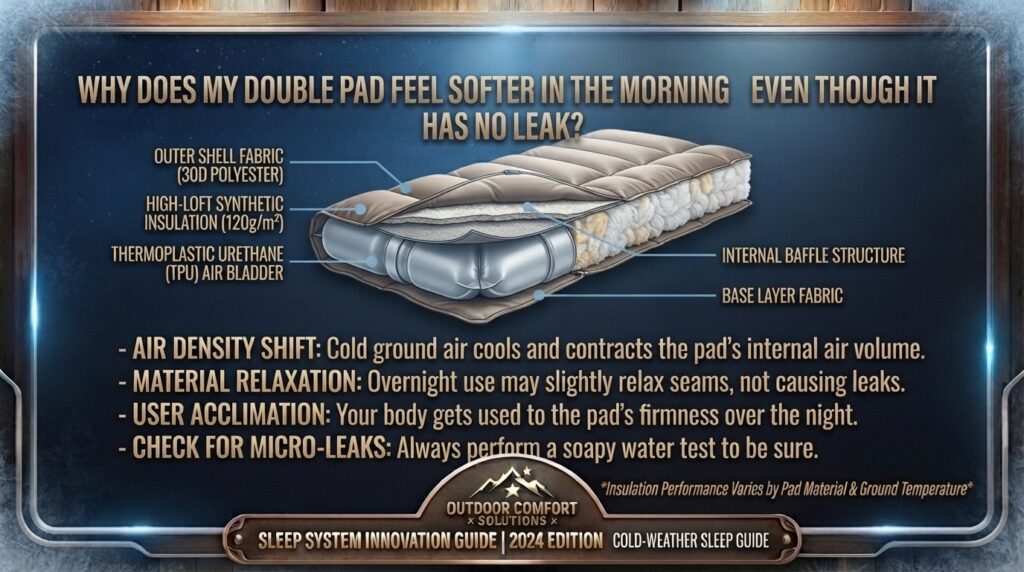
It is a scenario played out in backcountry camps across the world. You arrive at your spectacular destination, pitch your tent, and inflate your luxury two-person sleeping mat to a perfect, drum-tight firmness. You crawl into your sleeping quilt, completely comfortable and suspended well above the hard earth.
But when the first morning light hits the tent, you wake up to a frustrating reality: your hips are bottoming out against the ground, and the pad feels significantly softer and deflated.
Naturally, your first instinct is to assume a mechanical failure. You spend the next hour submersing your gear in cold streams or wiping it down with soapy water, desperately hunting for a microscopic tear or a faulty valve housing. Yet, the test reveals absolutely nothing—the pad is structurally flawless.
So, why does your double pad feel softer in the morning even though it has no leak?
The short, science-backed answer is that it is a result of thermal contraction, fabric relaxation, and atmospheric pressure changes.
When the warm air inside your pad cools down to match the freezing night ground, the air molecules lose kinetic energy and condense. Combined with the natural mechanical stretching of new synthetic nylon threads under your body weight, your pad loses internal pressure without losing a single atom of air. Because double pads hold twice the air volume of single mats, this physical effect is twice as noticeable.
Below, we will dive deep into the ideal gas laws, look at the mechanics of fabric elasticity, analyze how regional microclimates compound morning softness, and share field-tested strategies to keep your sleep system perfectly inflated.
1. The Physics of Morning Sag: Thermal Contraction & The Ideal Gas Law
To understand why a perfectly sealed pad loses its structural integrity overnight, we have to look at classical thermodynamics. The gas molecules trapped inside your inflatable double mat are completely governed by Charles’s Law, which states that the volume of a given mass of gas is directly proportional to its absolute temperature when the pressure remains constant.
$$\frac{V_1}{T_1} = \frac{V_2}{T_2} \implies P_1 V_1 = nRT$$
When you inflate your sleeping pad using a pump sack or your lungs during the late afternoon, the ambient air temperature inside your tent is relatively high. If you inflate it using your breath, that air enters the pad at roughly $98^\circ\text{F}$ ($37^\circ\text{C}$), loaded with warm moisture.
The Midnight Chill Cycle
As night falls, a thermodynamic shift occurs:
- The warm, active air molecules inside the pad transfer their heat via conduction directly into the cold ground underneath your tent floor.
- As the internal air temperature ($T$) drops from afternoon ambient levels down to the near-freezing ground temperature, the molecules lose kinetic energy, slow down, and cluster closer together.
- This drop in molecular movement causes a corresponding drop in the internal air pressure ($P$) pushing against the pad’s synthetic walls.
Because a double backpacking pad holds an immense volume of air—frequently between 180 to 240 liters—a minor drop in temperature results in a significant volumetric shift. The air inside the chamber contracts, leaving the pad feeling soft, loose, and under-inflated by morning, even though every molecule remains trapped inside.
2. The Mechanical Variable: Fabric Stretch and Material Relaxation
The second culprit behind morning pad sag is not chemical; it is mechanical. Inflatable sleeping pads are built using technical synthetic textiles—primarily Thermoplastic Polyurethane (TPU) laminated nylon or polyester.
When you unroll a pad that has been tightly compressed inside a packed backpack all day, the synthetic fibers are tightly coiled. Once you inflate the mattress to high pressure and lay the combined weight of two adult campers on top, you subject the fabric to continuous mechanical stress.
- Initial Tension: Nylon is naturally elastic. Under consistent body load, the microscopic weave of the fabric slowly yields, stretches, and expands.
- Volumetric Expansion: Even a tiny 1% to 2% structural stretch across the wide surface area of a massive double mat increases the overall internal volume capacity of the air bladder.
- The Result: With a larger internal volume space to fill and the exact same amount of air molecules inside, the internal pressure drops noticeably, resulting in a plush, soft surface by 3:00 AM.
3. Regional Climate Analysis: Environmental Impact Across America
Because myecoadventure.com provides targeted wilderness advice across distinct geographical zones, managing overnight pressure drops requires understanding how regional temperatures and atmospheric conditions behave.
Texas: Radical Desert Temperature Swings
Backpacking through the wide desert terrain of Big Bend National Park or the rocky tracks of the Guadalupe Mountains exposes gear to intense shifts.
- The Climate Variable: Extreme diurnal (day-to-night) temperature drops, often shifting by up to 45°F within a few hours.
- The Pad Reaction: You might inflate your double pad during a warm 85°F afternoon. By midnight, desert radiant cooling can plunge the air down to 40°F. This massive temperature drop triggers an immediate contraction of the internal air mass.
- The Local Reality: A pad that felt hard as a rock at 5:00 PM will feel like an under-inflated pool float by 2:00 AM purely due to desert thermal contraction.
New York: High Ground Moisture and Thermal Conduction
From the damp valleys of the Adirondacks to the forested ridges of the Catskills, Northeast backpacking introduces cold, saturated soils.
- The Climate Variable: High humidity paired with water-laden ground that acts as an exceptional thermal conductor.
- The Pad Reaction: Damp ground draws heat out of your sleeping system far faster than bone-dry earth. The warm air inside your pad is rapidly chilled by the cold, damp forest floor beneath your tent sheet.
- The Local Reality: The rate of internal cooling is accelerated in New York’s humid woods, causing the pad to soften within the first two hours of lying down.
California: High Altitude Elevation Shifts and Alpine Chills
Trekking along high Sierra routes like the John Muir Trail or camping in the high country of Yosemite means managing significant elevation variables.
- The Climate Variable: Low atmospheric pressure at high altitude, combined with sub-freezing alpine night drop-offs.
- The Pad Reaction: As you sleep, alpine temperatures plummet, causing rapid internal air condensation. Furthermore, if you inflate your pad down at a lower valley camp and hike up to a high ridge, the shifting external atmospheric pressure changes how stiff the pad fabric feels.
- The Local Reality: At 10,000 feet, the ambient cold combined with granite ground conduction ensures your double mat will experience maximum thermal contraction before midnight.
Washington State: Saturated Rainforest Microclimates
Exploring the rain-drenched tracks of the Olympic Peninsula or the glacial basins of the North Cascades presents unique humidity challenges.
- The Climate Variable: Near-100% relative humidity and near-freezing mountain conditions.
- The Pad Reaction: If you use your breath to inflate a double mat in the Pacific Northwest, you trap highly saturated, warm moisture inside the pad. As that internal vapor hits the cold air, it condenses into actual liquid water droplets inside the baffles.
- The Local Reality: Gas-to-liquid water condensation inside the mattress causes a dramatic drop in internal volume, making the pad go soft quickly while lowering its effective R-value insulation.
San Francisco Bay Area: Heavy Coastal Fog Layers
For backpackers taking quick trips to Point Reyes, Mount Tamalpais, or the Santa Cruz Mountains, marine layers dominate the night.
- The Climate Variable: Thick, cold marine fog that rolls in rapidly during the late afternoon, dropping ambient air temperatures instantly.
- The Pad Reaction: The sudden arrival of a damp marine layer rapidly cools the air inside a pad that was filled during a sunny afternoon hike.
- The Local Reality: The quick drop from a sunny 70°F afternoon to a foggy 48°F evening means your double pad will soften significantly before you even climb into your sleeping bag.
4. The Pro-Packer Solution: How to Stop the Midnight Sag
To prevent waking up on the cold ground due to natural thermal and fabric changes, incorporate this professional camp workflow into your evening routine:
1.The Early Pre-Inflation:Time: 5:00 PM.
The moment you set up your tent shelter in the late afternoon, fully inflate your double sleeping pad to maximum pressure using your dry pump sack. Do not wait until bedtime to fill it.
2.The Passive Thermal Equilibrium Phase:Time: 5:00 – 9:00 PM.
Leave the inflated pad alone inside the closed tent for a few hours. This allows the warm air trapped inside the mattress to cool down naturally, matching the drop in ground temperature, while giving the nylon fabric time to stretch out.
3.The Mandatory Bedtime Top-Off:Time: 9:30 PM.
Right before you zip yourself into your sleeping bag for the night, open the inflation valve. You will notice the pad already feels slightly softer. Add 2 to 4 extra strokes of air from your pump sack to refill the contracted space, sealing it up at its true stabilized thermal pressure.
5. Technical Comparison: Mattress Materials vs. Pressure Loss
Different sleeping pad materials handle thermal shifts and physical stretch in distinct ways. The matrix below evaluates how various configurations perform over an eight-hour night:
| Fabric / Architecture Type | Initial Stretch Rate | Thermal Contraction Sensitivity | Pressure Loss Perception | Best Environmental Fit |
| Ultralight 20D Nylon (Single Chamber) | High | Very High | Significant (Feels soft by morning) | Summer trips where low pack weight is your top priority. |
| Heavy-Duty 40D/70D Polyester | Very Low | Moderate | Minimal (Stays relatively firm) | Car camping, rough ground, and pet-friendly trips. |
| Dual-Chamber Independent Bladder | Low | Isolated per side | Low to Moderate | Alpine routes where partners want custom firmness. |
| Self-Inflating Open-Cell Foam Core | Negligible | Very Low (Foam structure holds shape) | Almost Zero | Deep winter expeditions and cold-weather hunting camps. |
6. Frequently Asked Questions (FAQ)
1. How can I definitively prove my double pad doesn’t have a hidden micro-leak?
To rule out a slow leak, fully inflate the pad, close the valves tightly, and submerge sections of it in a bathtub or a calm camp stream, watching for a steady stream of bubbles. Alternatively, wipe down the pressurized surface with a soapy water solution; a real puncture will quickly form a distinct, growing cluster of white foam bubbles.
2. Does inflating my sleeping pad with an electronic pump reduce morning softness?
Yes. Electronic mini-pumps draw cold, dry ambient air from the surrounding environment rather than warm, humid air from your lungs. Because the air pumped inside is already close to the ambient trail temperature, it experiences much less thermal contraction overnight.
3. Why does my double pad squeak so loudly when it gets soft?
When an air pad loses internal pressure and goes soft, the loose top fabric folds and rubs against itself or your sleeping bag nylon under your body weight. This fabric-on-fabric friction creates a loud, rubbery squeak. Keeping the pad fully pressurized via a bedtime top-off eliminates this extra noise.
4. Will a brand-new double pad stretch more than an old one?
Yes. Brand-new technical fabrics experience a breaking-in period during their first three to five nights of use. The synthetic threads stretch out to their maximum elastic limit under your body weight. Once broken in, the material stabilizes, and structural fabric relaxation drops significantly.
5. Does the weight of two campers cause the pad to lose air pressure faster?
No. The combined weight of two adults increases the initial mechanical stretch on the fabric walls, but it does not force air molecules out of a sealed valve. The drop in morning pressure is driven by temperature change and fabric expansion, not the weight of the sleepers.
6. Can a high ASTM R-value insulation pad prevent thermal contraction?
A high R-value pad (above 4.5) slows down the rate of heat transfer into the cold earth, which helps keep you warm. However, it cannot stop the air mass inside from eventually cooling down to match the steady ground temperature over an eight-hour night. The air will still contract, though the process happens more slowly.
7. Is it bad to leave my double pad fully inflated inside my tent during a hot day?
Yes, this is highly risky. While cold air contracts, hot air expands rapidly. If you leave a pad fully pressurized inside a closed tent during a hot Texas or California afternoon, the rising heat can expand the air volume to dangerous levels, risking a blown internal baffle or a seam failure. Always deflate your mat slightly if leaving it set up during the day.
8. Does a rectangular double pad sag more than a tapered mummy double pad?
Yes, slightly. Rectangular double pads hold a larger total volume of air than tapered mummy designs. Because there is more total air mass inside the chamber to experience thermal contraction, the physical softening effect can feel slightly more pronounced.
9. Can I use an insulated pad sheet to stop my pad from stretching?
A fitted polyester or fleece pad sheet cannot stop the internal TPU mattress walls from expanding under pressure. However, a tight sheet helps distribute your body weight more evenly across the surface matrix, which can reduce the feeling of deep, localized sinking at your hips and shoulders.
10. Does altitude change affect pad firmness as much as temperature?
Yes. If you inflate your sleeping pad at a high-elevation mountain pass and descend several thousand feet into a deep valley camp, the increasing weight of the external atmosphere will compress the pad from the outside, making it feel softer, independent of temperature shifts.
Conclusion: Embodying Self-Reliance on the Trail
Waking up to a soft, yielding double sleeping pad is rarely a sign of a ruined piece of gear or a frustrating puncture repair emergency. Instead, it is a classic demonstration of the basic laws of physics and materials science working right beneath your tent body.
By understanding that thermal contraction and fabric relaxation are completely normal backcountry processes, you can stop wasting valuable trail time hunting for imaginary leaks.
Integrating a simple, strategic pre-inflation and bedtime top-off into your camp routine allows you to easily maintain a stable, comfortable, and warm sleep system throughout the night.
Whether you are sleeping under the high desert stars of Texas or navigating the damp alpine zones of Washington, mastering these basic principles ensures you stay fully rested and ready for whatever adventure awaits.