
Do body types or muscle mass affect how much heat someone generates? Whether you are trail running through the damp, temperate rainforests of Washington’s Olympic Peninsula, walking along the windy waterfront of San Francisco’s Embarcadero, hiking the high alpine ridges of New York’s Adirondacks, or navigating a crisp desert morning in West Texas, you have likely noticed a fascinating human variable among your outdoor companions.
While one person is comfortably trekking in a light T-shirt, another right beside them is shivering beneath a fleece mid-layer and a windproof shell.
This stark contrast often prompts an intriguing physiological question: Do our unique body types, physical structures, and muscle mass directly dictate the volume of thermal heat our bodies generate and retain?
The scientific answer is a definitive yes. The human body is essentially a biological combustion engine, and just like mechanical engines, its thermal output depends entirely on the size of its cylinder block, the type of fuel it burns, and the surface area of its radiator. Your body composition—specifically your skeletal muscle mass, fat distribution, and total surface-area-to-mass ratio—serves as the ultimate thermostat governing your comfort, performance, and survival in the great outdoors.
This comprehensive, data-backed guide breaks down the complex biophysics of human heat production, contrasts how muscle and fat function as metabolic furnaces and thermal blankets, examines environmental interactions across diverse US climate zones, and provides actionable tips for tailoring your outdoor gear strategy to your specific body type.
1. The Biophysics of Human Heat Generation
To understand how individual body structures vary in heat production, we must look at the human body through two distinct thermodynamic lenses: thermogenesis (heat production) and thermal dissipation (heat loss).
Internal body temperature is managed by a continuous thermodynamic equation:
$$\text{Net Body Heat} = \text{Metabolic Heat Production} \pm \text{Radiation} \pm \text{Conduction} \pm \text{Convection} – \text{Evaporation}$$
To maintain a healthy core temperature of 98.6°F (37°C), your brain’s thermal control center—the hypothalamus—must balance these factors perfectly. However, the baseline values assigned to both sides of this equation are heavily influenced by your physical body type.
The Metabolic Furnace: Fat-Free Mass (FFM)
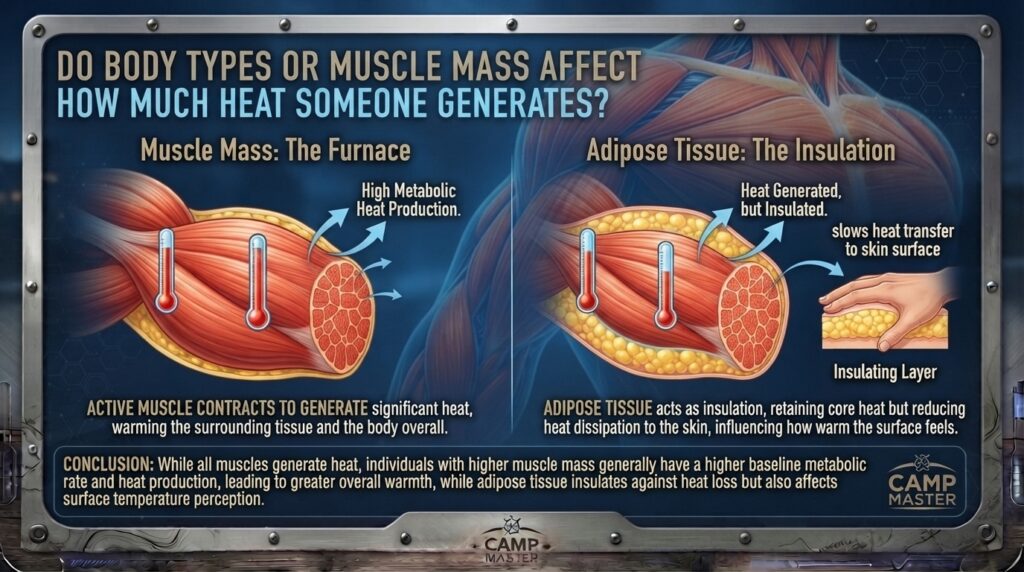
Every living tissue in the human body requires energy to exist, a baseline expenditure known as your Basal Metabolic Rate (BMR). However, not all tissues are created equal. Fat-Free Mass (FFM)—which comprises your skeletal muscles, organs, and bone structure—is highly metabolically active.
Skeletal muscle, even at absolute rest, is packed with mitochondria (the cellular power plants that convert food into Adenosine Triphosphate, or ATP). Because the biochemical process of creating and utilizing ATP is roughly 75% to 80% inefficient, the vast majority of that chemical energy is lost directly as pure, radiating metabolic heat.
Consequently, an individual with a high percentage of lean muscle mass possesses a fundamentally larger, hotter baseline furnace. They generate significantly more thermal wattage every single minute than someone of the exact same weight who carries a higher percentage of body fat.
2. The Somatotype Spectrum: How Body Types Regulate Heat
In fields like exercise science and anthropology, human body structures are broadly categorized into three primary somatotypes: Ectomorph, Mesomorph, and Endomorph. Each profile handles the balance between heat generation and heat loss in a completely unique way.
   [ ECTOMORPH ]             [ MESOMORPH ]             [ ENDOMORPH ]
  Tall, lean, thin          Muscular, dense           Broad, higher fat
 High Surface Area         High Heat Production       High Heat Retention
  (Efficient Radiator)      (Powerful Engine)        (Heavy Insulation)
1. The Ectomorph: The High-Surface Radiator
- Physical Characteristics: Tall, long-limbed, naturally thin, and lean with lower baseline muscle and fat mass.
- The Thermodynamic Dilemma: Ectomorphs have an exceptionally high surface-area-to-mass ratio ($SA:M$). This means they possess a massive amount of exposed skin (their radiator) relative to their internal body mass (their heat generator).
- Thermal Behavior: Because they have less muscle tissue to generate heat and less subcutaneous fat to trap it, ectomorphs dump thermal energy into the environment at an accelerated rate. They are highly prone to feeling cold quickly when physical activity ceases or when exposed to wind and dampness.
2. The Mesomorph: The High-Output Engine
- Physical Characteristics: Athletic, broad-shouldered, dense, with naturally high skeletal muscle mass and low-to-medium body fat.
- The Thermodynamic Dilemma: Mesomorphs possess an ideal combination for maximum heat generation. Their high concentration of skeletal muscle tissue acts as a high-wattage metabolic furnace during both rest and high-output activities like jogging or backpacking.
- Thermal Behavior: When active, a highly muscular individual can easily ramp up their internal heat production by 10 to 20 times above baseline, generating upwards of 1,000 Watts of continuous thermal power. They rarely struggle with cold environments while moving, but they must actively vent their gear to prevent excessive sweating.
3. The Endomorph: The Insulated Vault
- Physical Characteristics: Broader bone structure, shorter limbs, with a natural predisposition to storing higher percentages of body fat.
- The Thermodynamic Dilemma: Endomorphs possess a low surface-area-to-mass ratio ($SA:M$). They have less exposed skin surface area relative to their total volume, and they carry a thick layer of subcutaneous adipose tissue (fat).
- Thermal Behavior: Adipose tissue has a incredibly low thermal conductivity, meaning it acts as a highly effective thermal blanket. While an endomorph may not generate as much baseline muscular heat as a heavily muscled mesomorph, they retain the heat they do produce remarkably well. Their core temperature remains protected, but they can easily overheat during strenuous uphill climbs.
3. Quantitative Matrix: Tissue Type vs. Thermal Performance
The table below highlights the dramatic differences in how different tissue types inside the human body contribute to metabolic heat output, thermal insulation, and total body weight.
| Tissue Component | Metabolic Rate at Rest (kcal/kg/day) | Thermal Conductivity (W/m·°C) | Primary Thermodynamic Role | Impact During Active Exercise |
| Skeletal Muscle | ~13 kcal/kg/day | High (~0.38 W/m·°C) | Primary Heat Generator | Ramps up thermal output exponentially; pumps warm blood to the core. |
| Adipose Tissue (Fat) | ~4.5 kcal/kg/day | Exceptionally Low (~0.23 W/m·°C) | Primary Thermal Insulator | Acts as a barrier, trapping core heat while leaving outer skin feeling cool. |
| Internal Organs (Liver, Brain, Heart) | ~200 – 400 kcal/kg/day | Medium | Baseline Heat Anchor | Maintains baseline core temperature during absolute rest or sleep. |
4. Regional Climate Adaptations: Matching Body Types to US Environments
How your specific body type handles thermoregulation depends entirely on the atmospheric conditions around you. Let’s look at how these physiological profiles interact with distinct regional environments across the United States.
Washington & The Pacific Northwest (Damp, Cold Rainforests)
- The Climate Threat: High relative humidity, consistent cool mist, and low solar radiation.
- Body Type Impact: Damp air has a high thermal conductivity, drawing heat away from bare skin rapidly.
- The Ectomorph Risk: A lean ectomorph running or hiking in the Cascades will lose heat via conduction and convection at a rapid pace. Without high muscle mass to generate heat, they can slip into early-stage hypothermia if caught in a damp downpour without proper technical shells.
California & San Francisco (Microclimates & High Wind Chills)
- The Climate Threat: Rapid transitions from warm sun to biting, windy coastal fog.
- Body Type Impact: High wind creates intense convective heat loss, stripping away the thin layer of warm air trapped next to your skin.
- The Mesomorph Advantage: A muscular mesomorph jogging along San Francisco’s coastal paths generates plenty of active heat to counter the wind chill. However, if they wear unventilated gear, their high heat output will cause them to sweat heavily. The moment they stop, that sweat will switch to evaporative cooling, dropping their temperature quickly.
New York & The Northeast (Deep Winter Freezes)
- The Climate Threat: Sub-freezing temperatures, frozen terrain, and immense thermal gradients.
- Body Type Impact: When the air is 15°F, radiation pulls heat out of the body at maximum speed.
- The Endomorph Advantage: Endomorphs excel in this deep freeze due to their subcutaneous fat layers, which block internal core heat from escaping. Conversely, an ectomorph with minimal body fat will require substantially thicker artificial insulation layers (like high-loft down) to match the natural heat retention of an endomorph.
Texas (Arid Deserts to Intense Summer Heat Waves)
- The Climate Threat: Ambient air temperatures exceeding 100°F and high solar radiation.
- Body Type Impact: When the outside air is hotter than your skin, the environment pushes heat into the body, making sweat evaporation the only viable way to cool down.
- The Ectomorph Advantage: In the scorching Texas heat, the ectomorph’s high surface-area-to-mass ratio becomes a major advantage. Their large “radiator” allows them to dissipate heat via sweat evaporation far more efficiently than an endomorph or a heavily muscled mesomorph, both of whom run a much higher risk of heat exhaustion.
5. Tailored Gear Tips: Thermoregulation Strategies for Your Body Type
To optimize your comfort and safety during outdoor eco-adventures, tailor your layering system to match your specific body composition and metabolic output:
For the Lean Ectomorph (The Thin Radiator)
- Prioritize High-Loft Insulation: Because your body lacks a thick natural insulation layer, you must rely on high-loft mid-layers. Pack a premium down jacket or a high-weight synthetic fleece even for mild conditions.
- Seal the Radiator Closures: Pay close attention to your cuffs, collar, and hem. Use drawcords to seal off these escape routes, preventing convective wind currents from entering your gear system and stripping away your limited metabolic heat.
- Always Pack a Windproof Shell: Because you have a high surface area, wind affects you more than other body types. A dedicated, lightweight windproof shell is your most critical piece of defensive gear.
For the Muscular Mesomorph (The High-Output Engine)
- Choose Mechanical Venting Features: Look for jackets and shells equipped with deep pit zips, mesh-lined pockets, and two-way front zippers. This allows you to dump heat instantly during steep uphill climbs without having to remove your entire jacket.
- Utilize Grid Fleece Mid-Layers: Avoid bulky, solid insulation. Instead, choose a grid fleece that features channels designed to trap warm air when you are stationary, while allowing excess heat and sweat vapor to escape easily when you are moving.
- Embrace the “Be Bold, Start Cold” Rule: You will warm up faster than anyone else on the trail. Start your outdoor activity feeling slightly chilled; within ten minutes, your muscular engine will bring you to a perfect equilibrium.
For the Endomorph (The Insulated Vault)
- Focus on Superior Moisture Wicking: You will sweat easily because your subcutaneous fat traps heat so effectively. Your base layers must be made of high-performance synthetic materials (like polypropylene) or merino wool to actively pull moisture away from your skin.
- Adopt a Modular Layering System: Avoid thick, singular jackets. Instead, wear multiple thin, highly modular layers (a thin base layer, a lightweight wind vest, and a breathable outer shell) that you can easily add or remove as your exertion level changes.
- Protect Your Extremities: Because your body fat acts as a barrier trapping heat deep inside your torso, your skin surface and extremities (hands and feet) can actually feel surprisingly cold. Don’t assume your core is cold just because your hands are chilly—simply add insulated gloves while keeping your torso layers breathable.
6. 10 Deep-Dive Frequently Asked Questions (FAQs)
1. Does having more muscle mass mean you feel less cold?
Not necessarily. While a person with more muscle mass generates more internal heat, muscle tissue is highly vascularized and has a relatively high thermal conductivity compared to fat. This means muscle readily conducts heat out to the skin surface. If a muscular person stops moving in a cold environment, they will lose their heat quickly unless they trap it with proper insulation layers.
2. Why do people with higher body fat often complain that their skin feels cold?
Subcutaneous body fat acts as an incredibly effective thermal barrier. It prevents the warmth of your deep core blood from reaching the outer layers of your skin. As a result, the heat is trapped inside your torso vault, leaving the skin surface exposed to the cold air, which makes it feel chilly to the touch even though the core is perfectly warm.
3. Can you train your body to change how it handles cold temperatures?
Yes, through a process called cold acclimatization. Consistent exposure to cool environments triggers hormonal shifts, such as an increase in thyroid hormone activity, which raises your baseline metabolic rate. Additionally, it can stimulate the production of brown adipose tissue (BAT), a specialized type of fat that burns calories exclusively to generate heat, bypassing the need for shivering.
4. Who is more susceptible to hypothermia: a muscular person or a person with more body fat?
If both individuals are sitting completely still, the person with higher body fat is better protected against hypothermia due to the passive insulation properties of adipose tissue. However, if both individuals are actively moving (such as hiking or running), the muscular person can generate significantly more active metabolic heat, which can effectively stave off hypothermia as long as they keep moving.
5. Why do women generally feel the cold sooner than men?
On average, women have a lower total muscle mass and a higher surface-area-to-mass ratio than men. Additionally, women tend to have a more sensitive peripheral vasoconstriction response. When exposed to cold air, their blood vessels clamp down more aggressively to protect their core organs, shunting blood away from their hands and feet much sooner.
6. Do taller people lose heat faster than shorter people?
Yes. Taller, long-limbed individuals possess a much larger total surface area relative to their body weight than shorter, more compact individuals. This expanded surface area provides a larger zone for radiation and convection to pull heat away, meaning taller people generally lose heat faster in cold environments.
7. Does shivering burn as many calories as a standard muscular workout?
Shivering is an involuntary survival mechanism where skeletal muscles contract rapidly to generate emergency heat. Severe, full-body shivering can increase your baseline heat production by up to 4 to 5 times, burning a substantial number of calories and draining your body’s stored glycogen reserves at an alarming rate.
8. Why do I feel incredibly hot and sweaty immediately after I stop running?
This is a phenomenon known as afterburn or thermal lag. When you are running, the air moving past your body provides continuous convective cooling. The moment you stop moving, that airflow disappears completely, but your muscular engine is still pumping out high levels of residual metabolic heat, causing a temporary spike in sweating to dump the excess warmth.
9. Does drinking water help your body type regulate heat more effectively?
Yes, absolutely. Your blood plasma is the primary fluid used to transport heat throughout your body. If you are dehydrated, your blood volume drops and thickens, reducing the efficiency of your cardiovascular system. This makes it incredibly difficult for your body to send core warmth to your freezing extremities or to pump blood to your skin to cool you down in hot weather.
10. Can a person naturally have a higher baseline body temperature?
Yes, there is a natural biological variation in baseline body temperatures. While 98.6°F (37°C) is the historical average, healthy individuals can have normal resting core temperatures ranging anywhere from 97.7°F to 99.0°F. These minor differences are typically driven by genetics, thyroid function, age, and individual baseline metabolic rates.
Conclusion
Your body type is far more than just a visual aesthetic—it is the structural framework that dictates how your body interacts with the physical laws of thermodynamics.
By recognizing whether your body operates as a high-surface radiator (Ectomorph), a high-output muscular engine (Mesomorph), or an insulated thermal vault (Endomorph), you can move past generic outdoor advice and build a highly customized strategy for your gear, hydration, and pacing.
The next time you head out onto the trails of Washington, New York, California, or Texas, pay close attention to your body’s specific thermal profile. Listen to your personal thermostat, adjust your technical layers proactively before you start to heavily sweat or shiver, and enjoy the confidence that comes with knowing exactly how to manage your body’s thermal engine in any environment.