
Why do my hands and feet still feel freezing cold when I am actively jogging?

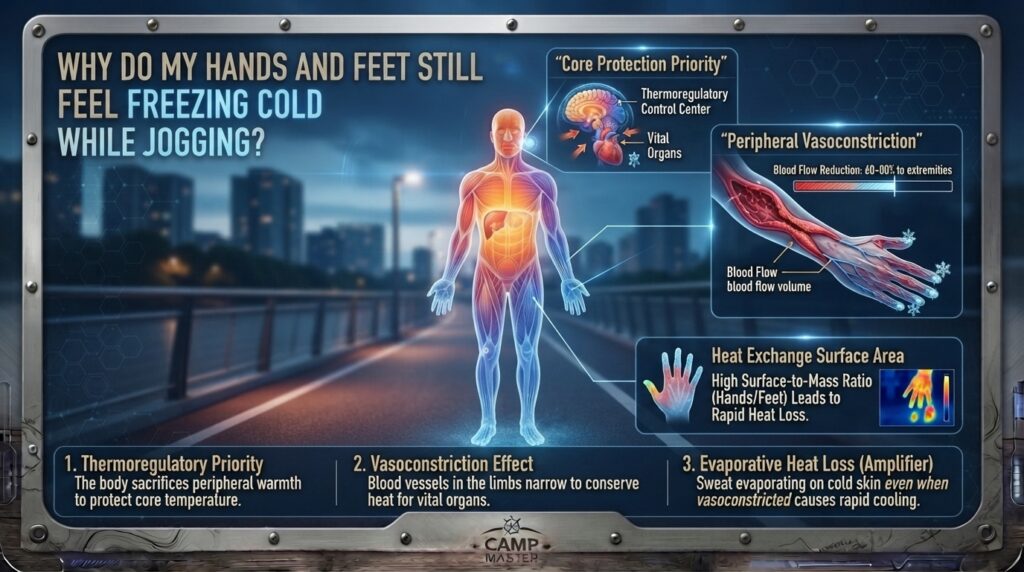
Why do my hands and feet still feel freezing cold when I am actively jogging? You’re mid-run, your breathing is rhythmic, your quadriceps and hamstrings are firing, and your forehead is beaded with sweat. By all accounts, your internal engine is roaring. In fact, on a crisp autumn morning along the text-book running paths of San Francisco’s Marina Green, an early winter trek through New York’s Central Park, or an uphill sprint in the alpine air of Washington’s Cascades, your major muscle groups are pumping out an impressive 500 to 700 Watts of pure thermal energy.
So why on earth can’t you feel your fingers? Why do your toes feel like blocks of ice inside your running shoes while the rest of your body is practically overheating?
This frustrating, counterintuitive phenomenon is one of the most common complaints among outdoor runners, joggers, and endurance athletes. It feels like a glitch in human engineering. However, having freezing hands and feet while actively jogging is not a mistake; it is the result of a highly sophisticated, evolutionary survival mechanism known as peripheral vasoconstriction.
To help you fix this on your next run, this comprehensive guide explores the complex cardiovascular physics of human thermoregulation, evaluates the critical role of environmental variables across varying US climates, maps out definitive gear and lifestyle tips, and provides a clear breakdown of when cold extremities point to an underlying medical condition.
1. The Anatomy of Shunting: Why Your Core Steals Your Extremity Heat
To solve the mystery of icy hands and feet during high-output exercise, we have to look closely at how the brain’s thermal control center—the hypothalamus—prioritizes resources when exposed to cold air or exercise stress.
Your body operates on a strict hierarchical survival model. Your core organs (heart, lungs, brain, liver, and kidneys) must be kept within a razor-thin temperature window near 98.6°F (37°C) to survive. If your core drops even a few degrees, hypothermia sets in, and metabolic systems fail. Your fingers, hands, toes, and feet, conversely, are evolutionary expendable pieces of tissue.
When you step out to jog in cool or windy weather, the cold ambient temperature immediately triggers the sympathetic nervous system. The hypothalamus sends an instant chemical command to the smooth muscle walls of the peripheral arterioles (the tiny blood vessels feeding your skin and extremities).
[ WARM / RESTING CALM ]
Arterioles wide open (Vasodilation) ──► Warm blood flows easily to fingers & toes.

[ COLD / JOGGING STRESS ]
Arterioles clamp shut (Vasoconstriction) ──► Blood is shunted away from skin/limbs back to the core.
This clamping process is called peripheral vasoconstriction. By dramatically reducing the volume of blood traveling through the wide surface area of your hands and feet, your body prevents your blood from acting as a radiator that dumps heat out into the cold air. The blood is “shunted” inward, pooling safely in your torso to keep your vital organs warm.
The Exercise Double-Whammy: Muscular Steal
When you are actively jogging, a secondary vascular phenomenon takes place: exercise-induced hyperemia (blood shunting to active muscles).
Your working legs and glutes require a massive, continuous supply of oxygenated blood to support cellular respiration. Your cardiovascular system responds by selectively opening blood vessels inside your active skeletal muscles while restricting blood flow to non-essential areas.
Because your hands aren’t doing heavy mechanical work while you run, they suffer a double-whammy: the cold environment forces vasoconstriction to protect your core, and your working leg muscles actively steal the remaining circulating blood volume. Until your entire core reaches a massive thermal surplus, your fingers and toes remain completely starved of warm blood flow.
2. Technical Matrix: The Thermoregulatory Spectrum During Exercise
The table below outlines how different zones of your body respond dynamically to blood flow distribution and temperature variations during a sustained 45-minute jog in 40°F (4.4°C) weather.
| Body Zone | Vascular State During Jog | Relative Blood Flow | Target Temperature | Primary Functional Role |
| Deep Core (Heart, Lungs) | Stable / Protected | Maximum | 98.6°F – 99.5°F | Sustaining metabolic life and baseline homeostasis. |
| Active Limbs (Thighs, Calves) | Vasodilation (Wide Open) | Exceptionally High | 96.0°F – 98.0°F | Executing mechanical work and generating metabolic heat. |
| Forehead & Torso Skin | Variable Evaporation | Medium | 90.0°F – 94.0°F | Releasing excess thermal energy via sweating to prevent overheating. |
| Extremities (Fingers, Toes) | Vasoconstriction (Clamped) | Minimally Low | 55.0°F – 70.0°F | Acting as a thermal barrier to lock heat inside the core. |
3. Environmental Drivers: How Local Climates Amplify Cold Extremities
The physical design of your body’s vascular system reacts radically to the atmospheric conditions around you. Depending on where you run in the United States, different environmental factors will exacerbate cold hands and feet during a jog.
1. San Francisco & Coastal California (Convective Wind Chill)
- The Atmospheric Culprit: High winds, maritime air, and dense, damp marine fog layers.
- The Thermodynamic Effect: San Francisco runners frequently experience freezing hands even when the ambient air temperature is a mild 52°F. The high wind speed creates intense convective heat loss. Wind aggressively strips away the microscopic boundary layer of warm air radiating off your bare skin.
- The Reaction: Because the hands are cutting through the wind continuously as you pump your arms, convective cooling forces instantaneous vasoconstriction, turning your fingers numb within the first mile.
2. Washington & The Pacific Northwest (Conductive Humidity)
- The Atmospheric Culprit: High relative humidity, persistent misty rain, and waterlogged running trails.
- The Thermodynamic Effect: Damp air has a significantly higher thermal conductivity than dry desert air. When moisture settles on your bare hands or seeps through the mesh toe box of your running shoes, it draws heat away from your skin up to 25 times faster than dry air.
- The Reaction: The cold, wet environment rapidly drains the baseline heat from your skin surfaces, forcing your peripheral arterioles to stay locked in a constricted state for the entirety of your run.
3. New York & The Northeast (Extreme Thermal Gradients)
- The Atmospheric Culprit: Deep winter freezes, sub-freezing air temperatures, and frozen asphalt.
- The Thermodynamic Effect: Running in the Northeast during winter exposes your feet to extreme conductive heat transfer. Every time your running shoe strikes the sub-freezing asphalt, heat travels from the warm sole of your foot, through the thin EVA foam cushion of the shoe, and dumps directly into the frozen ground.
- The Reaction: The huge temperature difference between your body and the sub-freezing environment leaves no room for error; your body locks down peripheral blood flow completely to protect its core.
4. Texas (High Day-to-Night Thermal Swings)
- The Atmospheric Culprit: Rapid morning temperature drops and low humidity in West/Central Texas.
- The Thermodynamic Effect: Texas runners frequently deal with dramatic 30-degree temperature drops at dawn. Running in dry, chilly desert air causes sweat to evaporate instantly.
- The Reaction: If you start a run wearing improper gear during a sudden cold snap, rapid evaporation from your torso skin fools your nervous system into thinking your core is dropping, causing a prolonged shutdown of blood flow to your fingers.
4. Primary Non-Environmental Causes of Cold Hands and Feet
If you find that your fingers and toes remain painfully frozen even when running indoors on a treadmill or during mild, warm summer afternoons, your symptoms may be driven by biological or lifestyle variables rather than simple environmental conditions.
Raynaud’s Phenomenon
Raynaud’s is a benign but painful vascular disorder characterized by hyper-reactive peripheral blood vessels. In individuals with Raynaud’s, the smooth muscles in the arterioles do not just gently constrict when exposed to cool air; they go into a complete, violent vasospasm.
[ Normal Vasoconstriction ]  ──► Blood flow is restricted but functional.
[ Raynaud's Vasospasm ]      ──► Vessel pinches shut completely; fingers turn white/blue.
During a Raynaud’s attack, blood flow to the fingers or toes is temporarily cut off entirely. The skin undergoes a distinct tri-phasic color change: White (as blood flow stops), Blue (as the stagnant oxygen in the tissue is depleted), and Red (as the spasm relaxes and blood rushes back in, often accompanied by intense throbbing or tingling). A minor temperature change, like running past a cold air conditioning vent or holding a chilled water bottle, can trigger an attack.
Nutritional Iron-Deficiency Anemia
Iron is the core structural element required to build hemoglobin, the specialized protein inside your red blood cells responsible for binding and transporting oxygen molecules. If your iron levels are chronically low, your body cannot produce enough functional red blood cells.
When you jog, your working leg muscles demand immense oxygen resources. If you are anemic, your limited oxygen supply is directed exclusively to those major working muscles and your core organs. Your body severely restricts blood flow to your hands and feet to preserve the oxygen carrying capacity for your survival systems, leaving your limbs feeling perpetually icy.
Poor Hydration and Low Blood Volume
Water is the primary matrix of your blood plasma. When you run without proper hydration, you lose substantial water weight through sweat and respiration, causing your overall blood volume to drop.
To maintain adequate blood pressure and keep your brain fully oxygenated despite lower fluid volumes, your body has to make a defensive choice: it cuts off circulation to the non-essential capillaries in your fingers and toes. Dehydrated blood also becomes noticeably thicker and more viscous, making it incredibly difficult to pump through the microscopic microvasculature of your fingertips.
5. 5 Actionable Tips to Keep Your Extremities Warm While Jogging
To override your body’s defensive shunting mechanism and keep blood flowing freely down to your fingertips and toes, incorporate these five proven field strategies into your running routine:
- The Pre-Warm Activation Strategy: Never step out onto a cold trail with cold hands. If your fingers are already chilly before you start your watch, your body will start the run in a state of vasoconstriction, and it can take upwards of 4 to 5 miles of running for your core to generate enough surplus heat to open those vessels back up. Do a dynamic warm-up inside your house—jumping jacks, arm circles, or high knees—until you feel a flush of true warmth in your hands before opening the door.
- Protect the Core and the Neck First: If you want warm hands, don’t just buy thicker gloves—wear a warmer vest or a windproof torso shell. If your core feels completely insulated and registers a temperature surplus, the hypothalamus will willingly relax its grip on your peripheral blood vessels, allowing warm blood to flow freely to your limbs. Additionally, wearing a neck gaiter protects the carotid arteries, preventing cold air from chilling the blood traveling directly up to your brain’s thermostat.
- The Arm Swings Trick: If you feel your fingers going numb mid-run, change your running mechanics temporarily. Drop your arms down fully extended by your sides and perform wide, exaggerated centrifugal arm circles or vigorous downward shakes. This physical movement leverages centrifugal force to mechanically push blood down through your brachial arteries and bypass vascular resistance, forcing warm blood into your fingertips.
- Implement the Wind-Block Shield: Standard knit gloves provide zero protection against convective wind chill; the wind cuts straight through the loops, chilling your skin. Upgrade to running gloves or mittens that feature a dedicated polyurethane wind-block membrane on the back of the hand. Mittens are naturally superior to standard gloves because they keep your fingers grouped together, trapping shared radiant heat inside a unified thermal pocket.
- Ditch Cotton Socks and Add Gaiters: Your toes are highly vulnerable to conductive cooling from wet roads. Never run in cotton socks, which retain moisture and act as a cold compress against your skin. Switch to high-performance merino wool or synthetic polypropylene socks, which naturally insulate even when wet. If you run in wet or snowy climates, add a pair of lightweight running gaiters over your shoes to prevent water from splashing down into your ankle collar.
6. 10 Comprehensive Frequently Asked Questions (FAQs)
1. Why do my hands stay freezing cold even when I am sweating heavily on my forehead?
Sweating is triggered when your core temperature rises and needs to dump excess heat. However, if the ambient air is cold or windy, your nervous system can simultaneously maintain localized peripheral vasoconstriction in your hands to prevent heat loss from your extremities. Your body essentially acts like a split system—sweating at the core to cool down while locking down the fingers to prevent cold entry.
2. Can running form or how I hold my hands cause them to become cold?
Yes. If you run with tightly clenched fists or hold your elbows at an excessively sharp, tense angle close to your chest, you create sustained muscular tension along your forearms and shoulders. This chronic tension can mechanically compress the brachial and radial arteries, reducing the efficiency of blood flow down into your hands. Keep your hands relaxed, as if you are gently holding a delicate egg.
3. Is it normal for my fingers to swell and throb when they finally warm up after a run?
Yes, this is a very common reaction known as reactive hyperemia. When you finish your run and step inside a warm room, your core relaxes its defensive hold and your constricted blood vessels open up rapidly (vasodilation). A sudden rush of warm blood floods the starved capillaries, causing a temporary inflammatory fluid shift that leads to tingling, throbbing, redness, and mild swelling.
4. How can I differentiate between normal cold hands and Raynaud’s Phenomenon?
Normal cold hands will feel progressively chilled and may look slightly pale or red. Raynaud’s Phenomenon involves a stark, dramatic visual transition where individual fingers turn completely stark white or deathly blue, looking distinctly drained of all blood. Raynaud’s attacks are typically accompanied by a sharp, painful, dead-numb sensation followed by intense burning throbbing when re-warming.
5. Does caffeine intake before a run make my hands and feet colder?
Yes, absolutely. Caffeine is a powerful central nervous system stimulant that triggers the release of adrenaline and causes direct systemic vasoconstriction. Drinking a strong cup of coffee or taking a high-caffeine pre-workout supplement right before stepping out into cold weather tells your blood vessels to clamp down, making your extremities significantly more vulnerable to the cold.
6. What type of running shoes are best for keeping toes from freezing in winter?
Standard summer running shoes feature an open engineered mesh toe box designed for maximum airflow to cool your feet down. In winter, this mesh lets freezing wind and water right inside. For cold-weather running, choose shoes with a tighter weave, water-resistant treatments, or a specialized Gore-Tex (GTX) membrane that blocks external wind and water while allowing internal sweat vapor to escape.
7. Should I use chemical hand warmers inside my running gloves?
Chemical hand warmers (like HotHands) are an excellent, safe solution for long winter runs. Placing them inside the palm or back-of-hand pocket of your running mittens provides a steady external heat source that keeps the local skin temperature high. This local warmth tricks the nearby nerves into keeping the blood vessels open, maintaining continuous natural blood flow.
8. Does low blood pressure cause cold hands during exercise?
Yes. If your baseline blood pressure is naturally low, your cardiovascular system lacks the high driving pressure required to effortlessly push blood through the microscopic, high-resistance capillary beds at the very tips of your fingers and toes, especially when major muscles are demanding the bulk of the circulation.
9. Can vitamin deficiencies contribute to chronically cold extremities?
Yes. Deficiencies in Vitamin B12 and Folate can lead to macrocytic anemia, which severely reduces your blood’s ability to transport oxygen efficiently. Additionally, low levels of Vitamin D can negatively impact thyroid function and metabolic efficiency, impairing your body’s baseline thermoregulation systems.
10. When should I see a doctor about my cold hands and feet during running?
You should consult a healthcare professional if your cold extremities are consistently accompanied by skin color changes (turning stark white or deep purple), if you develop unhealing sores or ulcers on your fingertips or toes, if the numbness persists for hours after you have fully re-warmed inside, or if you experience unexplained systemic fatigue, dizziness, or joint pain.
Conclusion
Experiencing freezing hands and feet while your core is actively working up a sweat during a jog is not a flaw—it is a testament to the evolutionary survival systems keeping your vital organs alive. By understanding that peripheral vasoconstriction and muscular blood stealing work together to isolate your extremities, you can stop fighting your body’s biology and start managing it intelligently.
Equip yourself with the right gear strategy: insulate your core to signal safety to your hypothalamus, wear dedicated wind-blocking mittens rather than porous knit gloves, pre-warm your body indoors before hit the trail, and stay impeccably hydrated to keep your blood flowing smoothly.
Whether you are running through the damp fogs of San Francisco, the deep winter freezes of New York, the crisp mountain trails of Washington, or a sudden dawn cold snap in Texas, these simple thermoregulatory adjustments will help you override the vascular shutdown, keep your fingers warm, and let you focus entirely on hitting your next mile split in absolute comfort.