Does physical activity really generate enough heat for body temperature

Does physical activity really generate enough heat for body temperature? When you step out onto a windswept trail in Washington’s Cascade Range, brace against a damp, freezing morning fog rolls past the Golden Gate Bridge in San Francisco, or prepare for a crisp autumn hike in the New York Adirondacks, your body undergoes an immediate, invisible transition. The air biting at your skin threatens to pull your core temperature down. Yet, within fifteen minutes of uphill hiking, you find yourself unzipping your shell, shedding layers, and actively sweating.
This dramatic shift highlights one of the most remarkable feats of human evolutionary biology: endothermic thermoregulation.
For years, outdoor enthusiasts, athletes, and survivalists have relied on the classic adage, “Keep moving to stay warm.” But if you look at the raw thermodynamics, it raises a profound physiological question: Does physical activity really generate enough heat to maintain, regulate, and even elevate your internal body temperature against freezing external environments?
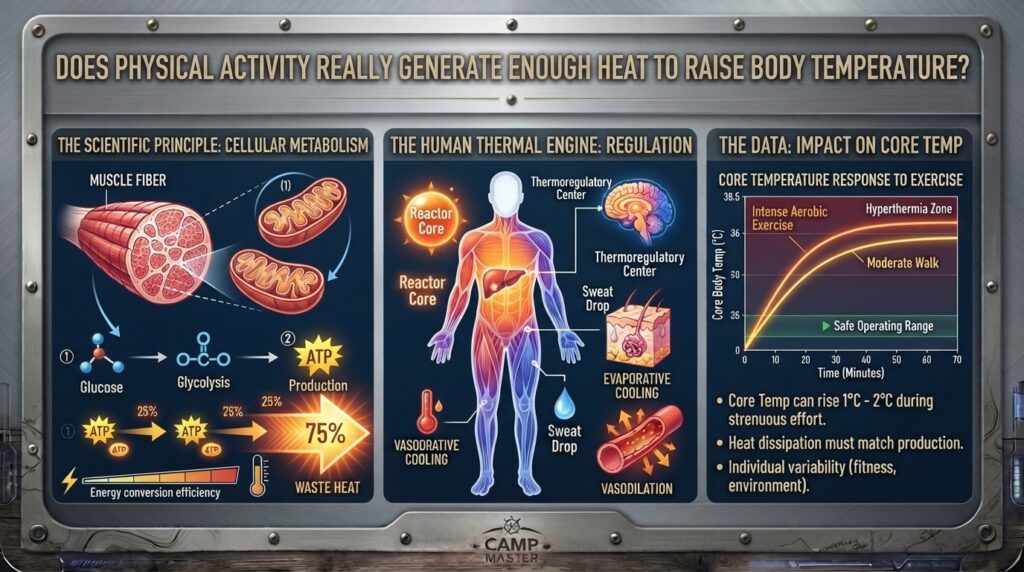
The short answer is an absolute, scientifically backed yes. In fact, your muscles are essentially highly sophisticated organic combustion engines. When you exercise, the chemical processes that power muscular contraction are remarkably inefficient—and in the world of human survival, that inefficiency is your greatest asset. Up to 80% of the energy consumed by your muscles during physical activity is lost as pure, radiating thermal heat.
This comprehensive, data-driven guide will break down the bioenergetics of heat production, explore how different types of exercise affect your core temperature, analyze the critical role of environmental variables across diverse US climates, and provide actionable survival tips for managing your body’s thermal engine in the great outdoors.
1. The Bioenergetics of Human Heat Generation
To understand how physical activity warms you up, we must examine the human body through the lens of thermodynamics. The human body behaves like a heat-producing machine that constantly burns fuel (carbohydrates, fats, and proteins) to create a high-energy molecule called Adenosine Triphosphate (ATP). ATP is the universal energy currency that allows your muscles to contract.
However, no engine is perfectly efficient. The mechanical efficiency of human skeletal muscle ranges between 20% and 25%.
$$\text{Mechanical Efficiency} = \frac{\text{Mechanical Work Output}}{\text{Total Energy Expended}} \times 100 \approx 20\% – 25\%$$
This means that for every 100 calories of chemical energy your body metabolizes during a jog or a steep climb, only 20 to 25 calories are converted into actual physical movement (like moving your legs forward or lifting your pack). The remaining 75% to 80% of that energy is converted directly into metabolic heat energy.
  [ Chemical Fuel: Food / ATP ]
               │
               ▼
  ┌─────────────────────────┐
  │  Muscular Contraction   │
  └────┬───────────────┬────┘
       │               │
       ▼ (20-25%)      ▼ (75-80%)
  [ Kinetic Work ]   [ Waste Thermal Heat ] ──► Warms Blood & Core
The Thermal Engine at Rest vs. In Motion
- Basal Metabolic Rate (BMR): When you are sitting completely still, your internal organs (heart, brain, liver, kidneys) generate a baseline level of heat known as your resting metabolic rate. This baseline maintains your core temperature at roughly 98.6°F (37°C), producing about 75 to 100 Watts of thermal power—roughly equivalent to an old-school incandescent lightbulb.
- Active Metabolic Rates: The moment you engage large muscle groups—such as your quadriceps, glutes, and hamstrings during an outdoor trek—your metabolic rate skyrockets. Strenuous physical activity can increase your body’s internal heat production by 10 to 20 times above resting levels. During intense exertion, the human body can pump out over 1,000 to 1,500 Watts of continuous thermal energy, transforming you into a powerful personal space heater.
This massive surge of thermal energy is absorbed by the blood flowing through your active muscles. This warmed blood is then pumped continuously throughout your cardiovascular loop, distributing vital heat directly to your core organs and brain, maintaining homeostasis even when exposed to severe ambient cold.
2. Quantitative Matrix: Metabolic Heat Production by Activity
Different outdoor activities demand varying levels of muscular workload, which directly dictates the amount of thermal energy your body’s engine yields. The table below outlines metabolic rates, measured in METs (Metabolic Equivalents), and translates them into approximate thermal wattage outputs for an average 165-pound (75 kg) adventurer.
What is a MET? One MET is defined as the amount of oxygen consumed while sitting at absolute rest, which equates to roughly 1.2 calories burned per minute for an average adult.
| Activity Description | MET Level | Total Energy Expenditure (kcal/hr) | Mechanical Work Output (Watts) | Active Thermal Heat Generation (Watts) | Core Temperature Impact |
| Absolute Rest / Sleeping | 1.0 | 75 kcal/hr | 0 W | 87 W | Baseline Homeostasis |
| Casual Camp Setup / Walking | 3.0 | 225 kcal/hr | 52 W | 209 W | Mild internal warming |
| Flat-Terrain Hiking (2.5 mph) | 4.3 | 322 kcal/hr | 75 W | 300 W | Steady, comfortable warmth |
| Heavy Backpacking (Uphill) | 8.0 | 600 kcal/hr | 140 W | 558 W | High heat; rapid sweating trigger |
| Trail Running / Mountain Jogging | 10.0 | 750 kcal/hr | 174 W | 698 W | Extreme heat; requires venting |
| Cross-Country Skiing (Vigorous) | 12.5 | 937 kcal/hr | 218 W | 871 W | Maximum sustained human heat |
3. How the Body Regulates the Heat: The Balancing Act
Because physical activity generates such a massive volume of internal heat, your brain’s thermal control center—the hypothalamus—must work around the clock to prevent your organs from literally cooking themselves. If your core temperature rises above 104°F (40°C), you risk heat stroke and cellular damage.
To keep the balance perfect, the body utilizes four distinct thermodynamic mechanisms to dissipate excess exercise heat into the surrounding environment.
1. Radiation
Radiation is the transfer of heat via infrared rays from the warm surface of your skin out into the cooler surrounding air. This process occurs completely automatically without any movement of air currents. If the ambient temperature is vastly colder than your skin, radiation operates at a highly accelerated rate.
2. Conduction
Conduction is the direct transfer of heat through physical contact with another surface. For instance, if you sit down on a freezing granite boulder in Yosemite or kneel in damp snow in the Cascade Range, your body heat conducts directly from your warm skin and clothing layers into the cold object, rapidly draining your thermal reserves.
3. Convection
Convection involves the transfer of heat away from the body by moving air or water currents. When cold wind blows across your exposed face or skin, it sweeps away the thin, microscopic layer of warm air trapped right next to your skin. This is the exact mechanism responsible for the wind chill factor.
4. Evaporation (The Double-Edged Sword)
When radiation, conduction, and convection are insufficient to cool down your exercising body, the hypothalamus activates your sweat glands. As moisture is pushed onto the surface of your skin, the liquid requires heat energy to transform into a vapor gas. It pulls this thermal energy directly from your skin, effectively cooling your blood.
The Backcountry Warning: While evaporation is a life-saver in hot weather, it is the number one enemy of winter survival. If you exercise too hard in cold weather and saturate your clothing layers with sweat, the moment you stop moving, that moisture will continue to evaporate and conduct heat away from you at an alarming rate—up to 25 times faster than dry air. This rapid heat drain can drop you into severe hypothermia within minutes.
4. Regional Climate Variables: Impact on Human Thermoregulation
A high-output physical activity that keeps you warm and perfectly balanced in one climate zone can become a dangerous survival risk in another. Let’s look at how regional environmental profiles across the United States affect your body’s thermal engine.
Washington & The Pacific Northwest (The Cascades & Coastal Rainforests)
- The Environmental Threat: High relative humidity, persistent drizzle, cool ambient temperatures (35°F to 50°F), and damp air.
- Thermodynamic Impact: High humidity severely limits the efficiency of sweat evaporation because the surrounding air is already saturated with moisture. Furthermore, damp air has a significantly higher thermal conductivity than bone-dry air.
- The Strategy: Because your generated heat is easily zapped by the wet environment, you must prioritize highly breathable, synthetic or merino wool insulation layers. Never wear cotton, which holds moisture like a sponge and kills your metabolic insulation value.
California & San Francisco (High Sierra Heights to Bay Area Wind Chill)
- The Environmental Threat: Extreme microclimate shifts, high wind speeds, and sudden elevation-induced temperature drops.
- Thermodynamic Impact: In San Francisco, a brisk coastal wind creates high convective heat loss, sweeping away your metabolic heat shield even during a vigorous run. Up in the Sierra Nevada mountains, the thin, dry alpine air accelerates evaporation, meaning you can lose massive amounts of body moisture without even realizing you are sweating.
- The Strategy: Wear a high-performance, windproof shell over your active insulation layers. This allows you to retain the raw thermal wattage generated by your legs while preventing convective wind currents from stripping it away.
New York & The Northeast (Adirondack & Catskill Winter Treks)
- The Environmental Threat: True deep-freeze temperatures, sub-zero wind chills, and deep snowpack.
- Thermodynamic Impact: When ambient temperatures drop below freezing, the thermal gradient between your 98.6°F core and the outside air is immense. Radiation and convection pull heat out of your body at maximum speed.
- The Strategy: You must maintain a steady, unhurried physical pace. Moving too slowly fails to generate enough metabolic heat to counter the deep freeze, but sprinting or pushing too hard triggers sweating, which compromises your insulation layers. Find the optimal steady tempo where you feel warm but completely dry.
Texas (Central Plains to West Texas Deserts)
- The Environmental Threat: High solar radiation, intense heat waves, and minimal shade canopy.
- Thermodynamic Impact: In places like Big Bend or the Texas Hill Country, ambient temperatures can often exceed your body’s internal core temperature. When the outside air is 105°F, radiation and convection work backward—pushing heat into your body. Physical activity adds massive internal heat to an already overloaded system.
- The Strategy: In these zones, physical activity should be strictly curtailed during peak daylight hours. Shift your hiking to early mornings or late evenings when your body can safely radiate its active heat output out into the cooler desert night.
5. Field Tips for Managing Your Body’s Thermal Engine
To master your internal temperature during outdoor adventures, implement these five practical, field-tested thermoregulation strategies:
- Be Bold, Start Cold: When you pull up to a cold trailhead, the temptation to step out of your car wrapped in a massive, puffy down jacket is incredibly strong. Resist it. If you start your hike feeling perfectly warm while standing still, you will be overheating and drenched in sweat within ten minutes. Start your activity feeling slightly chilled; within a mile, your muscles will ramp up to 300+ Watts of thermal output, bringing you to a perfect equilibrium.
- The Layering Adjustment Rule: Treat your clothing like a system of valves on an engine. The moment you feel a hill climbing steepness increase, immediately pull off your beanie, unzip your pit zips, or shed your mid-layer before you start heavily sweating. Conversely, the exact minute you stop to take a rest break, put your warm insulation layer back on immediately to trap the residual metabolic heat your muscles just generated.
- Hydrate to Circulate: Your blood is the coolant and the heat-delivery fluid of your body’s engine. If you become dehydrated, your blood volume drops, thickening its consistency. Dehydrated blood cannot efficiently travel to your small skin capillaries to cool you down when hot, nor can it efficiently circulate core warmth to your freezing fingers and toes when cold. Drink steady amounts of water even in freezing weather.
- Fuel the Furnace: You cannot generate metabolic heat without chemical fuel. On long backpacking trips, ensure you consume dense, high-calorie foods rich in complex fats and carbohydrates (like nuts, cheeses, chocolates, and nut butters). Your body requires these caloric blocks to keep the chemical ATP conversion process running smoothly over consecutive high-mileage days.
- Shivering is a Last Resort: If you stop moving and find yourself shivering uncontrollably, pay close attention. Shivering is your body’s involuntary emergency defense mechanism. It triggers rapid, microscopic skeletal muscle contractions that can boost resting heat production by up to 4 to 5 times (generating around 400 Watts of heat). However, shivering drains your remaining glycogen energy reserves incredibly fast. Treat it as a critical warning sign that you need to either resume active movement, consume quick sugars, or climb inside an insulated shelter system immediately.
6. 10 Deep-Dive Frequently Asked Questions (FAQs)
1. Can you freeze to death while actively running or walking?
Yes, it is entirely possible under extreme environmental conditions. If the ambient cold, moisture, and wind chill combine to pull heat out of your body faster than your maximum active metabolic rate can generate it (e.g., being caught in a wet, freezing blizzard without windproof gear), you will slide into hypothermia and eventual collapse despite continuous physical movement.
2. Does shivering count as a form of physical activity?
Yes, biochemically. Shivering consists of involuntary, rapid, and uncoordinated contractions of your skeletal muscles. It uses the exact same mechanical inefficiency principles as exercise—burning glycogen fuel and converting 80% of that energy directly into emergency thermal heat to raise your core temperature.
3. Why do my hands and feet still feel freezing cold when I am actively jogging?
When exposed to ambient cold, the hypothalamus activates a survival mechanism called peripheral vasoconstriction. It clamps down the tiny blood vessels leading to your extremities (hands, feet, nose, ears) to keep your warm blood pooled entirely in your vital core organs. Even if your core is roaring hot from a jog, your hands may stay cold until your core reaches a safe surplus of heat.
4. Does drinking hot liquids actually raise your body temperature?
The actual thermal mass of a cup of warm tea or broth adds only a tiny fraction of heat to your core. However, drinking hot liquids acts as a powerful psychological booster and warms the immediate blood vessels surrounding your esophagus and stomach. This creates a soothing, comforting sensation that can trick the hypothalamus into relaxing peripheral vasoconstriction, allowing warm blood to flow back to your hands.
5. Why do I feel suddenly freezing cold the minute I stop hiking?
The moment you halt physical movement, your muscular heat production drops instantly from a high active output (like 500 Watts) back down to your baseline resting rate (around 90 Watts). If you are drenched in sweat, that residual moisture will begin evaporating and conducting heat away from your skin at an accelerated rate, causing a rapid thermal crash.
6. Do body types or muscle mass affect how much heat someone generates?
Absolutely. Muscle tissue is highly metabolically active even at rest. Individuals with higher percentages of lean muscle mass naturally generate more baseline and active heat than those with lower muscle mass. Additionally, a larger body mass acts as a larger thermal sink, retaining generated heat longer than smaller, thin frames.
7. Does alcohol help keep your body warm during cold-weather exercise?
No, this is a dangerous myth. Alcohol is a powerful vasodilator, meaning it forces the blood vessels near your skin to open up widely. While this rushes warm blood to your skin surface—giving you a temporary, deceptive feeling of flush warmth—it actively drains heat away from your core organs, rapidly accelerating your true risk of hypothermia.
8. Is it true that you burn more calories when exercising in the cold?
Yes, slightly. When working out in cold environments, your body expends extra energy to maintain its core homeostasis temperature. If you get cold enough to start shivering, your caloric burn rate rises significantly because your muscles are working double-time to generate both movement and thermal heat.
9. Which macro-nutrient is best for keeping your internal body temperature stable?
Fats and complex carbohydrates are the best long-term fuels. Fats provide a dense, slow-burning source of sustained energy (9 calories per gram) that keeps your metabolism firing across long, cold days. Simple sugars provide a rapid, emergency spike in heat production but lead to a sharp energy crash shortly after.
10. Can you overheat while exercising in sub-zero freezing temperatures?
Yes, quite easily. If you wear heavy, unventilated waterproof clothing while performing high-output activities like snowshoeing or steep mountain climbing, the massive heat generated by your muscles gets completely trapped inside your clothing layers. This can drive your core temperature up to fever levels, inducing heat exhaustion amidst a freezing environment.
Conclusion
The human body is an absolute marvel of thermal engineering. Physical activity doesn’t just casually warm your skin—it actively transforms your entire muscular system into a highly capable power plant, yielding massive blocks of heat that serve as your first line of defense against the elements.
By understanding that 75% to 80% of your exercise energy is transformed directly into thermal heat, you can make highly calculated decisions on the trail. Whether you are navigating the damp valleys of Washington, the windy coastlines of San Francisco, the snowy peaks of New York, or the intense sun of Texas, the key to outdoor comfort and survival lies in mastering this internal engine.
Manage your pacing, regulate your clothing layers like valves to prevent sweat accumulation, fuel your metabolic furnace with premium caloric building blocks, and step out onto the trail with full confidence that your body has all the energy it needs to keep you warm, safe, and moving forward.